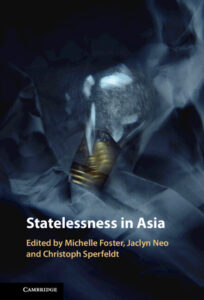
Statelessness in Asia addresses a significant research gap within the existing body of academic literature on statelessness—that statelessness exists and arises in contexts devoid of forced migration and prolonged refugee situations.
Covering 12 empirical cases, the volume highlights the many reasons why hundreds of thousands of people are without citizenship and suffer the resulting legal, political and social consequences.
Statelessness and intersecting issues
The book not only offers deep insights into the legal traditions and settings of statelessness in a range of Central, East, South and Southeast Asian countries, but conceptually speaking, each chapter highlights a specific nexus of statelessness.
Statelessness is discussed in the context of intersections with commonly examined parameters such as ethnicity, gender, marriage and age, but also in relation to less obvious connections, including Islamic terrorism, tourist economies and electoral participation. This makes for a highly informative, multi-perspective read. Each chapter has been thoroughly researched and well-edited, resulting in the entire volume being a great resource for both newcomers to the topic and experts.
Asia is the epicentre
Statelessness is a global phenomenon with at least 4.4 million persons being stateless or having undetermined nationality worldwide. But as the three editors of this collection make clear, Asia is the ‘epicentre’ (p. 3), with more than half of stateless people located there.
Despite long-standing efforts undertaken by the United Nations to end statelessness, many Asian nations have not yet signed or ratified the core international conventions to reduce and overcome statelessness. The reasons behind this are highly political and closely connected to ideas of sovereignty and national belonging, which derive from long-lasting colonial legacies. The latter manifests not only in sometimes arbitrarily drawn state borders that divide close-knit populations but also in the prevailing dominance of jus sanguinis, where citizenship is acquired through parents or ancestors rather than birthplace. Even after embracing independence, many states continued with classifications of populations similar to those under colonial administrations, treating some groups as ‘foreigners’ in their own country. The way state power over stateless people is exerted in contemporary Asia tends to be highly discriminatory and, more often than not, arbitrary.
While the rate of ratification of the U.N. conventions remains very low, parts of Asia have their own regional and national human rights instruments, which at least theoretically support the understanding that each person has a right to a nationality. But despite the existence of some relatively well-developed national legal frameworks, political will for implementation is often amiss, and ineffective bureaucracies make it cumbersome and costly for people to access their entitlements. It is no coincidence that many stateless people in Asia are also members of religious or ethnic minorities who face higher rates of inter-generational poverty, illiteracy, stigmatisation and marginalisation.
Divided into three parts, the contributors discuss, firstly, the phenomenon of statelessness, secondly, intersecting vulnerabilities and finally, challenges to change. Here, I highlight some contributions that I found particularly fascinating.
‘Ceylon Indians’
Kalyani Ramnath sheds light on the so-called ‘Ceylon Indians’ and their exclusion from voting rights once Sri Lanka became independent. Not only was this a further stigmatisation of migrants-turned-plantation-workers, but it was also a deliberate exclusion of voters who favoured leftist politics amid rising Sinhala Buddhist nationalism. As latter chapters in the edited volume attest, this historical example from Sri Lanka became the playbook for the politicisation of citizenship for electoral gain, also used in other places. This is demonstrated by Mohsin Alam Bhat in her writing on people in Assam, India, who have been declared to be ‘doubtful citizens’ and thus not eligible to vote, as well as being disconnected from basic services.
Children and young people
The impacts of statelessness on children and young people are addressed by several authors. Rodziana Mohamed Razali pays special attention to groups dealing with inherited statelessness (Rohingya in Myanmar, ethnic Vietnamese in Cambodia, children of Filipino parents in East Malaysia and so-called Hill Tribes in Thailand); as well as the consequences they face.
Looking at statelessness through the eyes of children also plays a key role in Janepicha Cheva-Isarakul’s chapter. Her highly innovative contribution derives from her repeat encounters with stateless youth. Following two young people over several years helps us understand how they learn to be stateless: a rather sobering way to describe how young people come to realise the differences between themselves and others in relation to citizenship. This involves a scaling-down of their educational ambitions once they grasp what life in Thailand does not hold for them.
Stateless children also feature prominently in Aziz Ismatov’s chapter, in which he discusses hidden forms of statelessness in several post-Soviet Central Asian republics. He argues that these new states did not intentionally exclude certain minorities (as the Baltic states did) or women, but just a few years after their independence the number of stateless women and children was on the rise. Law makers had simply not paid enough attention to common traditions, including cross-border marriages, patrilocal residence requirements and cumbersome bureaucracies.
Chinese and Vietnamese women in South Korea and Taiwan
Ismatov’s chapter is best read in conjunction with the contribution by Susan Kneebone who sheds light on South Korea and Taiwan, where foreign female spouses are deliberately discriminated against. The lived realities of marriage migrants from the Chinese mainland and Vietnam show that these women are not just legally disempowered, they are also considered socially inferior for being opportunists (p. 193). Yet these women face enormous expectations to be fertile and docile wives. They are expected to care for the elderly and rear children while fully conforming with dominant ethnic and cultural patriarchal ideologies. Little wonder that many of these cross-border marriages end in divorce and family break up. Kneebone specifically points out the high prevalence of domestic violence, leaving the women and their children in extremely precarious situations if their former nationality is cancelled and new nationality not yet granted.
‘Maritime mobile people’
The chapter by Greg Acciaoli and colleagues on stateless ‘maritime mobile people’ (communities who spend most of their time at sea, often referred to as sea nomads), offers detailed ethnographic observations about their exclusion from education and medical services, while also showing how governments in Thailand, Indonesia and the Philippines seek to commercialise their cultural heritage for tourism. Their findings show convincingly that that this ‘heritagisation’ is ‘another mode of denying rights, in this case cultural rights, to the mobile maritime communities’ (p. 258) that are already deeply afflicted by non-recognition and marginalisation.
Anti-terrorism policies in Indonesia
Just as interesting is the chapter by Matthew Seet who discusses anti-terrorism policies in Indonesia, introduced under former President Joko Widodo, which have stripped citizenship from people and their children who had fought for Islamist forces in Syria. Not allowed to return to Indonesia, they remain in legal limbo unwanted by other states. While a number of Western states have also impeded the return of their nationals from Syria, arguing that they are a serious risk to national security, Indonesia is the first Asian and Muslim majority country to adopt this denationalisation stance as a means to combat domestic terrorism (arguably a highly uncertain outcome). Moreover, it leaves the former combatants residing in countries in the Middle East that may be even less capable of de-radicalising them or prosecuting them for whatever crimes they may have committed.
Myanmar
In light of the of the many highly complex and often seemingly desperate situations confronted in this edited volume, two chapters are a bit more hopeful. Nyi Nyi Kyaw analyses the situation in Myanmar after the 2021 military coup. The Rohingya people are not acknowledged as citizens by Myanmar authorities and are one of the largest groups of stateless people in the world. The author, somewhat surprisingly, sees indications for progressive change, pointing out that other ethnic groups in Myanmar that are fighting the military government have made public apologies to the Rohingya about the violence they’ve suffered and issued statements indicating they want a more inclusive approach. Considering the fast-changing developments on the ground and the consolidation of the miliary junta after the most recent elections (neither free nor fair), this window of opportunity might be closing quickly once again.
The Philippines
The final chapter deals with the long-awaited ratification of the 1954 Statelessness Convention by the Philippines and its subsequent accession to the 1961 Reduction of Statelessness Convention. Francis Tom Temprosa scrutinises the key domestic and international actors that endorsed the ratification, a process spanning almost six decades, rather than examining the subsequent changes and implementation on the ground post-ratification. While the political context in the Philippines is unique and might not offer a path for other Asian countries to follow, his underlying analysis could potentially influence global debates on ending statelessness and is an optimistic note on which to end.
Book cover image used with the permission of Cambridge University Press.
Main image: A work from an exhibition called Restless Earth, that examined experiences of migrants, refugees and statelessness, 2017. Credit: Matteo Bittanti. Flickr.