Indonesia continues to struggle with religious violence in the democratic era, including attacks against individuals or communities, discriminatory legal regulations and terrorism. Religious violence most commonly occurs against Christians, Ahmadi Muslims and Shia Muslims, groups that are specifically targeted for their faith and cultural practices. Many Indigenous communities also struggle with marginalisation and land dispossession because their beliefs are not afforded formal recognition by the state.
In the post-Suharto era, the dispersal of authority across regional and local governments has also contributed to a proliferation of discriminatory religious regulations which often fail to protect religious minorities. Yet while populist rhetoric against minorities remains a potent political dynamic, tolerance remains a prominent theme across civil and political discourse.
If global challenges can better be addressed by engaging with Indigenous knowledge—as is often claimed—how might Indigenous knowledge shape engagement with issues of religious pluralism, in Indonesia and beyond?
Contemporary expressions of gotong royong (mutual assistance)
In a small village in Central Java, Indonesia, a young student of theology (mentored by theologian and co-author of this article, Hery Susanto), gathered his friends and family to discuss Christian faith on a weekly basis. These meetings, held in his home, were quietly accepted by the majority Muslim community, until a small group of hardline Islamists moved to the village to intentionally stir unrest and threaten violence if the gatherings continued. The outbreak of violence in such situations is not uncommon, as a recent attack on a Christian prayer group shows.
Rather than withdraw or retaliate, this small community approached the local imam with an offer: to demonstrate the value of their faith for the wider community. Soon, they had installed a bore and pump to provide clean drinking water for the village and began volunteering as parking attendants at the local mosque for Friday prayers.
Their actions were not designed to appease but expressed a theological commitment encouraged by the Churches of Christ in Indonesia (Gereja Jemaat Kristus Indonesia), which sees Christian faith as a practice of bringing peace to the local neighbourhood. These actions were also understood to express the traditional Javanese ethos of gotong royong (mutual assistance). Rather than seeking a protected space of difference, this small house church considered both Christian and Indonesian identity as something essentially expressed through tolerant and generous relations with others.
Understanding ethical dynamics within communities like this is essential to an informed and nuanced consideration of Indigenous knowledge in Indonesia, especially where reference to kearifan lokal (local wisdom) such as gotong royong invokes forms of life that are shared across diverse traditions and religions.
The gotong royong ethos
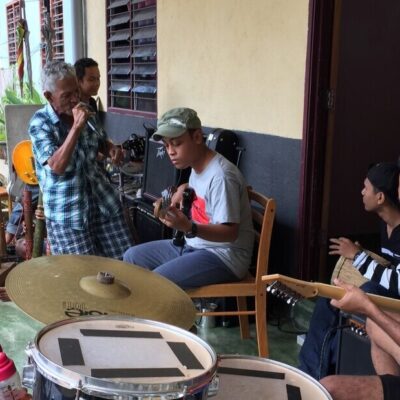
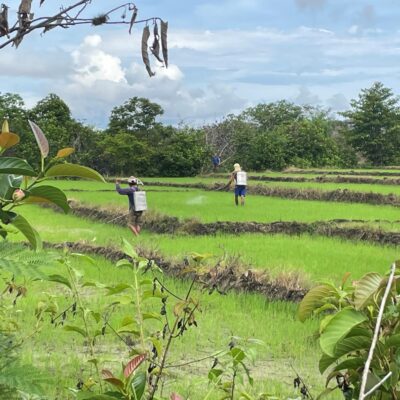
For many Indonesians, the actions of the Christian community described above are recognisable expressions of gotong royong, a form of mutual assistance widely celebrated as a social ethos, particularly within Javanese community life. The term, which translates literally as ‘to lift or carry together,’ names a broader set of cooperative practices found across Indonesia and under different local expressions. Gotong royong refers to collective responses to local challenges, whether family crises, natural disasters, the need for public works, agricultural labour or to perform burial rituals.
Similar practices found across the Indonesian archipelago emphasise interdependence and shared responsibility as a core ethos shaping community life.
While long embedded in everyday social life, gotong royong was systematised and popularised within scholarly and national discourse through the work of anthropologists such as Koentjaraningrat, especially in relation to Java. The term was elevated in the mid-twentieth century as a symbol of Indonesian identity, tied closely to the founding state-philosophy of Pancasila. For some, gotong royong is therefore a means of state-centric social engineering, promoted to foster social citizenship, cooperation and achieve the goals of independence; for others, it is a genuine lower-class, rural tradition that has been usefully utilised by state administration to mobilise village labour and promote a development agenda.
Gotong royong as Indigenous knowledge?
One approach to gotong royong as Indigenous knowledge would be to explore historical practices found across Java and other parts of Indonesia, to uncover a traditional concept that has become entangled in politics and abstracted from local forms. Another approach would be to consider gotong royong as an interpretive disposition that has been adapted within a range of new and complex scenarios.
Indigenous knowledge commonly refers to ‘the understanding and practices developed by Indigenous communities over generations.’ Because Indigenous knowledge is distinctly grounded in cultural experiences and relationships with place, it is commonly framed through narratives of marginalisation and minority status.
Typically, this leads to a focus on the retention of pre-modern practices and beliefs. As a result, Indigenous knowledge is often valued because it stands apart from forms of modern, colonial or cosmopolitan culture and society.
By approaching Indigenous knowledge as an interpretive disposition, a different set of questions is raised: How are diverse forms of knowledge engaged within and across cultures and traditions? How does an ethos like gotong royong shape diverse communities today?
While this focus might appear to pull away from local autonomy and the expression of inherited practices, attention to the interpretive dynamics of knowledge can strengthen Indigenous capacity and decision-making. Observing a broader, national ethos of gotong royong in local bahuma (farming) practices among the Banjar people, for instance, can affirm Indigenous land management, kinship and governance practices, cherished because they express widely recognised values.
To consider these possibilities, we further explore gotong royong as an Indigenous ethos that foregrounds ethical relations rather than symbolic or ideological discourse. Approached in this way, gotong royong can support cooperative religious and cultural pluralism.
Gotong royong as the impetus of Pancasila
Gotong royong has been widely critiqued as a political construction of the Indonesian state. Yet it can also be interpreted as an original impetus that shaped the formation of Pancasila, the foundational state philosophy, and its reception.
The five principles of Pancasila were formalised in 1945 during the country’s transition to independence. These principles—belief in divinity (ketuhanan), humanity, national unity, deliberation and consensus, and social justice—have been used to promote unity in a religiously and ethnically diverse society. More than abstract ideals, Pancasila is a political and cultural program intended to bring about bhinneka tunggal ika (unity in diversity).
For many Indonesians, the drafting of Pancasila was experienced as a generous gesture that provided space for religious and cultural freedom. But Pancasila has also been used coercively. Under President Suharto’s New Order regime (1967–1998), it was declared the azas tunggal (sole principle) for all political and social organisations, utilised as a mechanism of ideological control.
The 2020 Pancasila Bill further fuelled political contest over its meaning, with various groups attempting to encapsulate Indonesian identity within their own religious or political discourses.
For statesman Sjafruddin Prawiranegara, Prime Minister of the Pemerintah Revolusioner Republik Indonesia (Revolutionary Government of the Republic of Indonesia, 1958–61), this political coercion went against gotong royong as the original impetus of Pancasila. In an open letter to the president of the People’s Consultative Assembly (17 July 1983), he imagined the flourishing of Indonesia through the fertile interactions of diverse peoples and religions, whether Muslim, Christian, Buddhist or Hindu. For Prawiranegara, gotong royong allows each individual to retain a distinct identity while contributing to a common civic life:
‘If Muslims cannot establish organizations based upon Islamic principles, and the same is the case for other citizens espousing other religions or ideologies … then Indonesia, this fertile and prosperous country … must, as it were, be transformed into a barren Sahara desert, consisting of only stones and undifferentiated particles of sand [yang zatnya sama].’
Prawiranegara’s view emphasises gotong royong as an interpretive disposition necessary for pluralism to flourish. This is a view of diversity realised through everyday acts of care and mutual responsibility, rather than the bureaucratic authorisation of distinct identities or activities within the state.
In the words of Soekarno, the first President of Indonesia, Pancasila is a framework in which ‘all religions have space to live.’ However, it is gotong royong that remains essential to the realisation of that vision, functioning as an ethical impetus to work cooperatively with those who are different.
This reading casts Indigenous knowledge as more than heritage or cultural content to be acknowledged and protected; it emphasises the enduring value of traditional wisdom, in sustaining certain kinds of relations across generations and contexts.
Indigenous knowledge and Christian experience
Approaching Indigenous knowledge as interpretive practice resonates with the relational hermeneutics of many Christians in Indonesia. For Susanto, Christian faith is not a fixed inheritance, but something formed and sustained through tangible expressions of love for neighbour: visiting the sick, cleaning streets, tutoring students, providing safe drinking water and developing sustainable agricultural businesses. Christian identity, he writes, must be ‘experienced in the midst of life,’ not reduced to doctrinal adherence or ritual observance.
Whereas the Indonesian state frames religious identities bureaucratically—through affiliation and compliance—Susanto insists that Christian faith can express gotong royong and a distinctly Indonesian ethos of cooperation, human dignity and social justice.
Like seasoning that can enhance the rasa (flavour) of Indonesian society, Christians should be concerned with building peaceful communities and not the doctrinal demarcation of beliefs—so that ‘the quality of one’s faith has a real impact on society.’ Such examples from Christian theology and practice offer several complexities and possibilities of interpreting Indigenous knowledge within pluralist settings.
Elsewhere, scholars have similarly shown how the practice of Islamic law has been adapted through gotong royong, demonstrating flexibility in aligning with local culture, supporting social inclusion and shaping interfaith dialogue.
The risk remains that Indigenous knowledge is abstracted or instrumentalised when severed from its local groundings. Any exploration of these interpretive dynamics should not displace Indigenous self-determination in articulating ethics and identity but enhance the capacity of diverse communities across Indonesia to engage meaningfully with Indigenous people.
Religious pluralism and practical wisdom
In Indonesia, an individual’s religion is authorised via official registration (such as identity cards) and inherited cultural practices that mark religious communities as distinct. Similarly, Indigenous identity is often understood through the lens of customary practices and cultural heritage.
If these forms of recognition help to manage difference within a plural society, they do little to cultivate mutual understanding across differences.
Approaching Indigenous knowledge as an interpretive ethos suggests another path. It directs attention not to symbolic identities but shows how common values are sustained through lived commitments and inheritances. This is exemplified by gotong royong as a form of practical wisdom and capacity to act responsively—not because of legal mandate but because of a deeper sense of mutual responsibility.
As scholar Otto Gusti Madung—Rector of the Ledalero Institute of Philosophy and Technology in Maumere, East Nusa Tenggara province, Indonesia—argues, the promotion of religious tolerance in Indonesia also requires a greater degree of critical thinking in religious and secular education. Drawing on philosopher Charles Taylor, he argues that religious teaching in Indonesia too often defers to institutional authority and presents faith as a fixed inheritance, rather than interpreting faith as a distinct set of epistemological commitments. This permits only a narrow social and ethical imagination. By contrast, a more reflexive approach to religious beliefs understands faith and identity as dynamic, formed among and alongside others.
Religion can motivate expressions of gotong royong that resonate across diverse beliefs and experiences. Tolerance is more than a structure of inclusion but, as Madung reflects on the value of Christian faith in secular Indonesia, can imbue humans with ‘an inner volition to greet one another with acceptance and love.’ He argues that other religions and atheistic humanism can offer similar orientations.
Such reflections resonate with philosopher John Gray that pluralism cannot rest on agreement about ultimate truths or shared moral purposes but must rest on shared forms of life—social practices, habits of thought, and institutions that enable people with divergent values to live together and negotiate difference, even where there is disagreement about ultimate truth, purpose or virtue. Gray writes, ‘Differences of religious belief and of irreligion, of conceptions of the good and of ethnic inheritance may be many and significant, and yet the inhabitants of a country may yet be recognisably practitioners of a shared form of life.’
Approached through the interpretive maturity of Prawiranegara, Susanto, Madung and Gray’s pluralism, gotong royong does more than furnish a national ideology with rhetorical appeal. Rather, it is an ethos that can nurture ethical capacity and the practical wisdom necessary for plural societies to flourish. This requires accommodation, compromise and recognition of the limits of reason in resolving deep disagreement.
The experience of Christians in Indonesia can also inform ways of thinking about Indigenous knowledge within plural societies, where distinct traditions and beliefs underpin mutual responsiveness and cooperation. Differences of religion, tradition and culture are a fact of life: attempts to legislate pluralism through ideological or procedural means can become oppressive unless grounded in those aspects of tradition and culture that constitute shared experience.
In this way, Christian interpretations of gotong royong should renew focus on the living, interpretive dynamics of Indigenous knowledge that show it to be much more than cultural heritage. The goal here is not to redefine or appropriate Indigenous knowledge, but to draw attention to one of its most enduring features: the living, interpretive practices through which life together becomes meaningful.
Authors: Dr Samuel Curkpatrick and Hery Susanto.
Image: Indonesian women working together (mutual assistance ‘gotong royong’), October 2016. Credit: Andesta Suaputra/Wiki Commons.