New research suggests some fathers are coming together to reconstruct their roles, support gender equality and change understandings of masculinity in Indonesia.
The term ‘fatherless country’ has been applied to Indonesia in recent years. Although the label lacks strong empirical support, it has triggered public debate, particularly following the 2024 enactment of the Undang-Undang Kesehatan Ibu dan Anak (UU KIA – Maternal and Child Health Law). The law grants fathers only two days of leave after their child is born, reinforcing concerns about the limited institutional support for paternal involvement in parenting.
The term ‘fatherless’ carries a different meaning in Indonesia to its usage in the Global North, particularly in countries such as the United States. In those contexts, it typically refers to children growing up without a resident father, often associated with family breakdown. In Indonesia, however, the label more commonly applies to fathers who are physically present but emotionally absent. This form of disengagement stems from entrenched gender norms that designate caregiving as the exclusive responsibility of mothers.
I argue that in contemporary Indonesia, amid shifting socio-political conditions, some fathers are coming together to reconstruct their roles. These efforts offer insight into how contemporary understandings of masculinity in Indonesia are evolving.
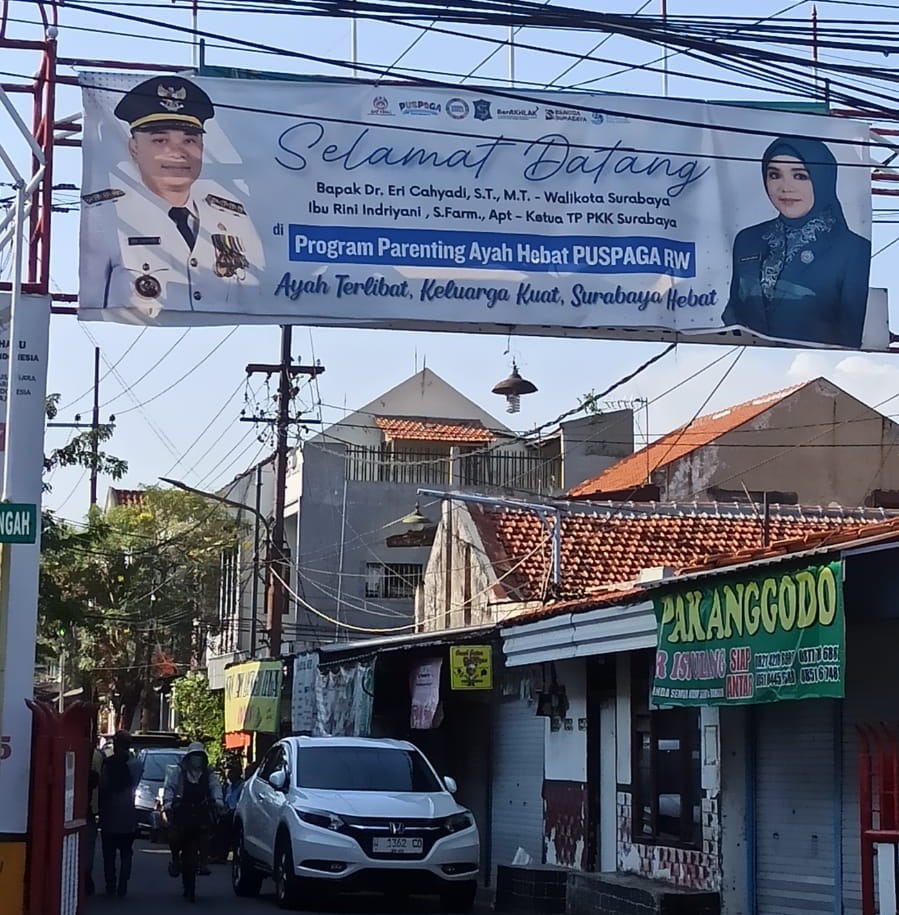
Image 2: Street banner in Surabaya about a program called ‘Parenting Ayah Hebat’ which aims to involve fathers in parenting, 2023. Credit: Author.
The image of fatherhood during Indonesia’s New Order era and Reformasi
Understanding contemporary fatherhood practices cannot be separated from how Indonesia—especially during the authoritarian New Order era (1966–1998)—constructed the image and idea of the ideal father, and masculinity in general. Therefore, it is important to examine how the regime during this period, along with the political dynamics and socio-cultural shifts that followed, shaped notions of fatherhood.
Indonesia’s New Order under President Soeharto was marked by a rigid segregation of gender roles. The state endorsed bapakism, an ideology that positioned men primarily as breadwinners and financial providers, detached from domestic responsibilities such as childcare. Through bapakism, Soeharto also presented himself as the ‘father of the nation’ and the ‘father of national development’ (bapak pembangunan). This ideology drew from Javanese cultural values, emphasising patriarchal roles in which familial obedience was centred around the father figure (bapak). This framework shaped both formal policies and informal social norms, reinforcing an image of fathers as emotionally distant and uninvolved in the home.
Alongside this, the state promoted ibuism, which framed women as devoted wives and mothers—pillars of family stability and essential to national development. Together, these ideologies reinforced a hegemonic model of masculinity—one that emphasised strength, capability, emotional detachment, and control.
Changing attitudes
The collapse of the New Order in 1998, alongside the global rise of third-wave feminism in the 1990s, created space for more nuanced gender relations in Indonesia. During the Reformasi (era of Reform) period, particularly under President Abdurrahman Wahid (1999–2001), there was a stronger push for gender equality. This era also saw increased involvement from international NGOs, which played a significant role in shaping visions of a more inclusive and equitable Indonesia.
One early state-supported initiative was the Suami SIAGA (Alert Husband) program, launched in 1999 by the Ministry of Health with support from the United Nations Population Fund (UNFPA) and Johns Hopkins University. Aimed at increasing male involvement in maternal health, the initiative responded to Indonesia’s high maternal mortality rate and poor healthcare infrastructure. The program aligned with broader global movements such as India’s ‘Men Against Violence’ and Abuse (MAVA), the Netherlands’ ‘Emancipator’, and the US-based ‘A Call to Men’, as well as transnational networks such as MenEngage and MenCare that promote caregiving as a path to gender equality.
In the contemporary era, male-involvement in gender equality activism in Indonesia has expanded. The Aliansi Laki-laki Baru (New Men’s Alliance), established in 2009, encourages men to actively support women’s rights and challenge conventional gender norms. This alliance was founded by a group of men, led by three collective coordinators and five area coordinators, with its main activities focused on advocating for gender equality through campaigns, discussions, and other programs. One of the founders, Nur Hasyim, is based in Semarang, Central Java, so most of their activities take place in Java. However, they also operate elsewhere through regional coordinators in Aceh, Kepulauan Riau, Jakarta, Yogyakarta, and Kupang. Some of their programs are conducted online in collaboration with other organisations, such as Magdalene, Airlangga University, Existensil, the Indonesia Business Coalition for Women Empowerment, and others. Because of their contributions to advancing gender equality discourse from a male perspective, they have been featured in Indonesia’s mainstream media, including Kompas, Media Indonesia, Tempo, and Antara. Highlighting their growing visibility and significance in Indonesia’s gender-equality movement, several scholars have also studied this community, including Prasakti Ramadhana Fahadi on social media advocacy for gender equality among Indonesian men, and Elisabeth Simaibang and Atwar Bajari on the representation of Aliansi Laki-Laki Baru as male feminists on social media.
Fatherhood-focused communities
At the grassroots level, Fatherhood-focused communities—such as Ayah ASI (Breastfeeding Fathers), BumilPakmil, Fatherman.id, and AyahBerkisah.id—have gained momentum, particularly through social media. These communities were also initiated by men, with the primary aim of promoting fathers’ involvement in domestic responsibilities. Each is organised according to its activities—for example, Fatherman.id incorporates Islamic teachings into its advocacy efforts.
What does the research indicate about how much have attitudes changed?
I argue that although gender equality initiatives have become more advanced due to a more open socio-political context in the Reformasi era, the position of men—including in the urban middle-class context—remains fairly traditional. Some research supports this claim. A 2015 research report by Rutgers World Population Fund Indonesia, titled State of the World’s Fathers: Country Report: Indonesia, emphasises how the media often portrays the ideal urban man as someone who has a wife and two children, owns a car as a symbol of modern status, and is supported by a domestic worker. In this scenario, the man is not expected to be involved in household matters such as childcare, as these are handled by the domestic worker under the supervision of his wife. Research by scholars Hani Yulindrasari and Kate McGregor in 2021 highlights that motherhood continues to be the core prescribed identity for women, while the role of protector remains central to the identity of fathers. Their research focuses on discourse analysis of the middle-class Indonesian parenting magazine Ayahbunda from 2000–2008. It clearly shows that the magazine promoted idealised gender roles for both women and men in middle-class Indonesian families, exemplified through the notions of the ‘super-mum’ and ‘super-dad’, portraying an idealised form of parenting that blends traditional responsibilities with ‘modern’ expectations—balancing household management, emotional care, provider roles, and social presence.
The Ayah ASI community
In 2023, I conducted a research project titled ‘It Takes Two to Raise the Children: Ayah ASI Community and Urban Middle-Class Fatherhood in Contemporary Indonesia’ (forthcoming in the Journal of Family Studies). Ayah ASI (which translates to ‘breastfeeding father’) is a community of urban middle-class fathers in Indonesia—typically with higher education and stable jobs—who actively support breastfeeding. They are highly active on social media—particularly Instagram, where they had more than 108,000 followers as of December 2025. Their content promotes the importance of breastfeeding and encourages shared household responsibilities. Beyond the digital space, Ayah ASI also runs offline events and training sessions, teaching fathers’ practical skills related to infant care and care for breastfeeding mothers. Some of their activities are run voluntarily, but others are supported by third parties such as UNICEF, universities, regional governments, and other NGOs or communities.
To communicate messages about fatherhood, Ayah ASI uses humour that resonates with other fathers. Shared ‘dad jokes’ are an example: ‘You go to the workshop and get your hands dirty changing oil—so why not clean your own child’s poop?’ This approach is not unique to Ayah ASI; many fatherhood communities on Instagram use similar strategies to make their content more relatable and engaging. Accounts such as @Bapak2id and @Bapakrumahtangga (stay-at-home fathers) also rely on dad jokes and humour to reach their audiences.
I focused on Ayah ASI because their work seeks to reshape how society understands fatherhood. By inviting more men to learn, participate, and support their partners, the community challenges conventional gender roles.
From my analysis of their Instagram content and interviews with followers and active members of the community, it is clear that Ayah ASI occupies a paradoxical position. On one hand, it challenges hegemonic masculinity. On the other, it reflects and sustains aspects of it.
Active fatherhood
Ayah ASI uses its social media platform to reject the image of the absent father and instead promotes a narrative of active, involved fatherhood. On Instagram, the community shares images that capture the warmth of father–child relationships through shared activities such as reading, bathing, carrying, and physical activities. It deliberately avoids reinforcing the traditional breadwinner image, often tied to hegemonic masculinity. Instead, Ayah ASI highlights how fathers can support mothers’ breastfeeding by sharing childcare duties equally with their partners. This message is delivered through a mix of ‘dad jokes’, educational posts, offline training, webinars, and other community-led activities.
Fathers involved in the Ayah ASI community show a clear interest in learning about and participating in domestic roles. In a patriarchal society where such responsibilities are typically seen as women’s domain, this engagement challenges traditional ideas of masculinity built on self-reliance and dominance. Instead, these men acknowledge that men need to be actively involved in parenting and domestic duties if there is to be gender equality. They read parenting books, attend parenting classes and learn infant care from their wives and parents. They also express anxiety, feelings of incompetence, and offer support to one another when facing challenges—traits that stand in contrast to hegemonic ideals of masculinity.
My research indicates that the men involved in the Ayah ASI community develop useful caregiving skills. Fathers train themselves to respond to their children’s needs—tuning into sounds, gestures, and emotional cues to better hold and soothe infants; as well as changing diapers, bathing them and preparing solid food.
Navigating contradictions
Not surprisingly, the breadwinner role for men has not entirely disappeared within the Ayah ASI community. Fathers continue to negotiate their roles as both breadwinners and caregivers, depending on their individual circumstances. Some take on caregiving duties at night after returning from work. Others rely on digital tools to stay connected with their children while working far from home.
Only a few have become full-time stay-at-home dads. Fathers in the Ayah ASI community also face structural barriers around limited institutional support such as paid paternal leave, which also remains a problem in the Global North but to a lesser extent. For non-traditional gender roles to occur—such as fathers being fully involved in caregiving and mothers participating more in the paid labour market—Indonesia’s socio-economic structure needs significant change. The gender pay gap, for instance, often makes it financially difficult for women to earn enough for the household, which in turn limits the possibility of men taking on primary caregiving roles. Men with higher education levels and stable jobs, may have secure employment but are not granted opportunities to take leave for domestic responsibilities. Parental leave is even less attainable for fathers in rural or lower-income settings, where patriarchal expectations and economic precarity strengthen traditional forms of masculinity.
Given that breastfeeding is closely tied to women’s bodies, Ayah ASI’s work raises complex questions about men’s roles in this space. Its focus on helping women breastfeed may be welcomed by many mothers who choose to do so. But men’s promotion of breastfeeding has a history of being a form of misogynistic control over women’s bodies; and the promotion of breastfeeding, rather than bottle feeding, means that in practical terms men cannot become involved in feeding for at least six months of an infant’s life. The involvement of men’s groups in this space is a complex space that deserves more research. Furthermore, many feminist scholars have argued that breastfeeding is often overstated in terms of its health benefits and public health significance, which can undermine women’s autonomy. In the Ayah ASI case, fathers chose to engage with the issue of breastfeeding, rather than other gender equality issues, due to the emphasis placed on it from a public health perspective, as Indonesia’s exclusive breastfeeding rate is still low—41 percent in 2019. This opens up further discussion about the health benefits of breastfeeding, women’s agency, and male authority, with different scientific perspectives used as justification.
In addition, men within the community have expressed problematic views, such as this post: ‘Please, for women who just finished breastfeeding, don’t forget to close your bra because it makes me horny’. This illustrates the tension within male-led gender equality initiatives and that patriarchal ideas are difficult to fully unlearn, even among those trying to become ‘progressive’.
Envisioning the Future of Men’s Studies in Indonesia
These developments suggest that fatherhood in contemporary Indonesia warrants deeper attention. While gender studies in Indonesia have extensively explored femininity and womanhood, masculinity is often treated reductively—as the source of gender inequality—without accounting for its evolving forms.
This article calls for more productive engagement with issues of fatherhood and masculinity—areas that have received sustained attention in the Global North since the 1980s. In Indonesia’s unique context as a post-colonial, Muslim-majority democracy with vast cultural diversity, examining the evolving practices of fatherhood is crucial. Doing so can deepen and diversify the country’s gender and sexuality discourse, which has historically focused more on femininity and womanhood.
Related articles:
Gender activism in Indonesia and the post-Reformasi era.
Main image: A father and baby, Indonesia. Credit: Rendi iD/Pexels.