In the story ‘Bah Luj and the Garuda’, Bah Luj, the male hero, leaps forward to slash the seven heads of the monstrous garuda, a mythological bird-like creature[1]. By defeating the garuda, Bah Luj, the Indigenous Orang Asli hero, enables the Malay sultan to reclaim his village and ultimately marry the sultan’s daughter.
This tale reveals subtle ways in which Orang Asli storytellers revalorise the status of the Semai male whose position has long been subjugated and oppressed—first through slavery under Malay sultanates, then colonial disempowerment, and more recently unequal post-colonial power structures. In decolonising the stereotypical notion of “masculinity” that has proliferated through Western theories and perceptions, this article offers an alternative perspective that may be more relevant and useful for addressing contemporary issues. These influences have tended to impose a notion of masculinity which emphasises power, competitiveness and dominance.
This article shows how Semai storytellers rearticulate manhood in ways that resist historical marginalisation and assert Indigenous agency. By reimagining ‘masculinity’ in Bah Luj’s character—through wisdom, respect for gender roles, and supernatural abilities—Semai storytellers challenge external ideals of manhood by foregrounding their own cultural strengths and values.
I revisit my ethnographic materials from the past to understand how these traditional frameworks might help today’s children navigate the shifting perceptions of gender in modern society. I do not seek to prescribe fixed notions of gender roles, but rather to encourage the current generation to reflect on their own roles and responsibilities through the lens of Indigenous wisdom. In addition, I recognise that ‘traditional’ ideals are unable to be fully separated from processes of societal change from ‘outside’, but merely seek to emphasise the traits of masculinity emphasised in the contemporary retelling of Bah Luj folk tales.
The Semai Indigenous ethnic group
The Semai are among the 18 Indigenous ethnic groups collectively referred to as the Orang Asli (Malay: orang – people; asli – original) of Peninsular Malaysia. The Semai traditionally inhabit rainforest areas along the foothills of the Titiwangsa Range.
Within this system, gender identities were shaped by occupational responsibilities associated with biological males and females—each making valuable contributions to the community’s endurance and the preservation of their biodiverse environment. The roles and responsibilities within the Indigenous Orang Asli communities were historically shaped by the necessity of survival in a challenging natural environment. Every role was crucial to the group’s endurance in the rainforest. Semai men, in particular, sustained spiritual relationships with entities known as guniq (spirit guides), who were believed to assist them in hunting, cultivation, and healing practises. Semai women played an equally important role in the survival of formerly nomadic groups; they cultivated gardens of tapioca and tubers, which made a vital contribution to the community’s staple diet.
Over time, however, the Semai ideal of manhood has become intertwined with notions of masculinity shaped by Malaysia’s encounters with colonisation, modernisation and development. These external forces have progressively undermined Semai men’s agency in maintaining traditional livelihoods, transmitting Indigenous knowledge, and exercising community leadership.
The erosion of these traditional roles has consequently undermined the expression of Semai masculinity, but their storytellers are quietly voicing their concerns[2]. Through age-old tales passed from generation to generation, these storytellers find witty ways to challenge outside ideas of masculinity and reclaim what it means to be a Semai man today.
Reasserting positive masculinity through the re-telling of the Bah Luj story
At the heart of the traditional stories is Bah Luj, a brave male hero who appears in four stories told by two elder storytellers: Bah Luj and the Evil Spirit, Bah Luj and his Five brothers, Bah Luj and the Seven Bataks, and Bah Luj and the Garuda.[3] Through the character of Bah Luj, they bring to life the courage, wisdom, and compassion that once defined Semai manhood. In doing so, they remind their community of the values that sustained their ancestors: cooperation, respect for the forest, and balance between men and women.
These storytellers—the late Bah Kang Bah Mat from Kampung Bukit Terang, Kampar, Perak, and the late Harun bin Itam, Kampung Serigala, Ulu Selangor—are more than keepers of tradition; they are voices of empowerment. Their stories aim to revitalise community pride and resist the forces that have taken away Semai land, livelihoods, and identity. By reasserting the dignity and importance of Semai men, I believe the storytellers hope to revive the balance that existed with Semai society.
Masculinity centred on communal responsibility
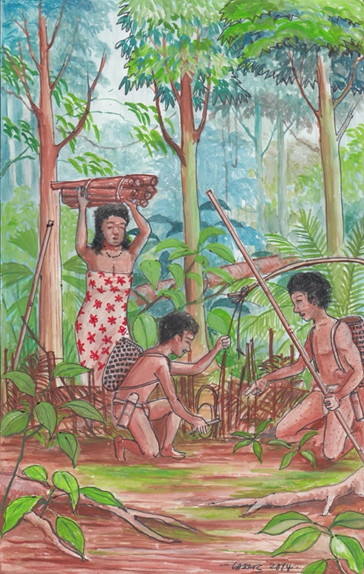
Figure 1. Bah Luj teaches his son how to build an animal trap from the story Bah Luj and the Seven Bataks. Used with permission from Pandak Basri Kana.
Among the Semai, masculinity is based on the qualities of humility, wisdom and wit, men’s occupational role, and their spiritual powers. In Bah Luj and the Seven Bataks, Bah Luj marries and establishes a farm with his wife. Together, they cultivate dry rice paddies, cassava, sweet potatoes, sugar cane, and bananas. As a father, Bah Luj instils in his son the essential skills of hunting, trapping, fishing, and building. While Bah Luj leads most activities, his wife actively participates in others, cultivating tubers and yams, gathering edible shoots, leaves, and forest vegetables, herbs and fruit. Bah Luj teaches his son to identify lubuk (deep waterholes), where fish such as seluang (minnow), kelah (golden mahseer), and tengas (jungle mahseer) are found in abundance. Semai women also assisted their husbands to place bubu traps (fish traps) and deer traps[4]. In addition, Bah Luj instructs his son in land-clearing practices—cutting, burning, and preparing the soil for hill rice paddies, as well as planting bananas, cassava, sweet potatoes, and sorghum.
This story highlights a core aspect of Semai masculinity: the ability of men to provide for their families through farming, hunting, and mastery of forest knowledge. Bah Luj embodies the ideal man not only through his physical skills but also through his role as teacher and transmitter of knowledge to the next generation. Rather than presenting masculinity as domination over women, the narrative situates it within a cooperative framework, where male responsibility, cognitive ability, and spiritual balance are emphasised as the hallmarks of an ideal Semai man.
Masculinity as restoring Indigenous pride and identity
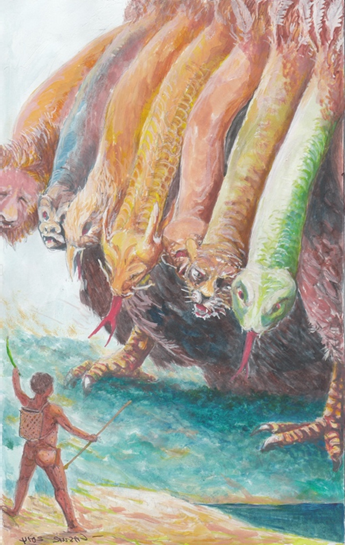
Figure 2. Bah Luj soars into the sky and swiftly decapitates the seven heads of the garuda from the story Bah Luj and the Garuda. Used with permission from Pandak Basri Kana.
Bah Luj was said to have been born with a natural gift and was often aided by a guniq (spirit guide) from the supernatural world. The guniq is a spirit guide with whom the shaman maintains a special relationship. The shaman summons the guniq for assistance, particularly in matters involving healing people who are sick. Bah Luj also possessed skills in shamanism, which were taught to him by the guniq. In Bah Luj and the Garuda, Bah Luj is described as a poor quail hunter but renowned for his wisdom and magical powers. In this story, he saves the people of a Malay village from the attack of the garuda. Assisted by his guniq he receives a paddy stalk that eventually transforms into a magical sword. With this, Bah Luj soars into the sky and swiftly decapitates the seven heads of the Garuda. He then declares:
‘Tuj Amen sah eng kenon Luj, Sengoi betuah. Eng sengoi sakti. Eng sap mangkei Garuda adih hadi pulau, untuk mengneng keon cemok eng cicit mol song’ [5]
‘Tuj! If I am the youngest son, the lucky child, the sacred child, I swear that the Garuda’s carcass will become an island, a keepsake for our children’s memory’
This excerpt from the story recounts that masculinity in the figure of Bah Luj is embodied in his supernatural powers, which were believed to be innate gifts. This mystical prowess—combining bravery, spiritual protection, and the ability to defend his people—resonates deeply with the Semai conception of masculinity.
At the same time, the tale reflects a broader theme of resistance: Bah Luj’s triumph over the Garuda symbolises the Semai struggle against overwhelming external threats. In Bah Luj and the Garuda, masculinity among the Semai can also be understood as the courage and ability to assert oneself in situations of unfair treatment. One means of doing so is through storytelling, which allows for the symbolic reversal of existing dominance by other ethnic groups. The story of Bah Luj and the Garuda explores the relationship between the Orang Asli and Malay royalty. Historically, male Malay rulers often married Orang Asli women as a means of legitimising their claims to native lands. In contrast, the narrative of Bah Luj reverses this historical dynamic: Bah Luj not only wins the heart of a Malay princess but also saves her village from destruction by the garuda. This reconfiguration of power reflects the storyteller’s deliberate effort to empower Bah Luj who ultimately marries the Malay princess.
After Bah Luj defeats the garuda, the Malay king crowns him as the new Sultan and gives him his daughter’s hand in marriage. The late Harun bin Itam, who narrated this story, strategically crafted it to celebrate the agency of a marginalised Indigenous group over the dominant ruling class. Bah Luj’s masculinity in this story is defined by his cognitive and spiritual abilities—his wisdom, wit, and cunning. At the same time, it encompasses his capacity to provide agency to his people and to challenge hegemonic authority. In this context, masculinity transcends physical strength: it embodies the power to assert dignity, restore pride, and reimagine indigenous identity within broader socio-political structures.
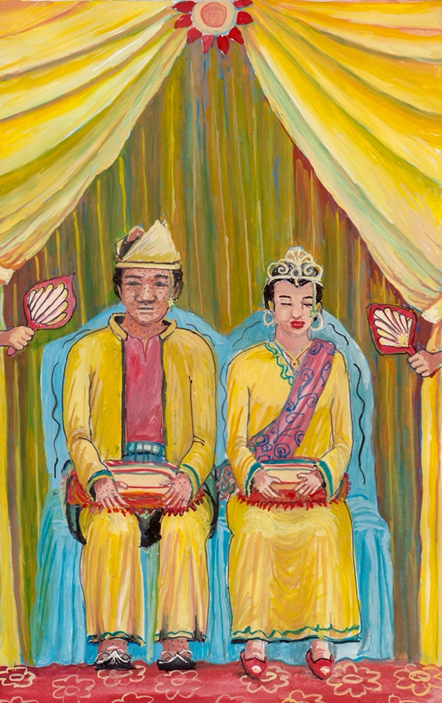
Figure 3. Bah Luj, the Indigenous Semai hero marries the Malay princess in Bah Luj and the Garuda. Used with permission from Pandak Basri Kana.
Masculinity as wisdom and spiritual agency
In Bah Luj and the Seven Bataks, Bah Luj outwits and kills the Bataks who had devoured his wife and children. ‘Bataks’ is a collective term referring to several ethnic groups, such as the Alas, Toba, Mandailing, and Singkil, who were historically associated with cannibalism. They are also remembered as gop sangkil (Austronesian slave traders) who captured Orang Asli women and children. In this story, the Semai storyteller strategically inverts the historical power dynamics between the Semai and the Bataks. Bah Luj cleverly squeezes the intoxicating juice of the perah fruit into the cikah (monkey) meat he prepares for the Bataks—a subtle yet ingenious strategy that ensures his victory.
‘Sedap betol menasak Luj!’
Lumom kipateh Bah Luj, panei bercet sej mungar.
‘Caknak tik jengoi, cak agok selsel,’ pedir Bah Luj.
‘Sedap. Bencoq, ingoi kemek,” pedir lumom.[6]
‘It’s very delicious!
Luj, you are indeed a great cook,’ they said.
‘Eat more, don’t be shy, there’s plenty of food left,’ Bah Luj urged.
‘Delicious… buttery…’ replied one of them.
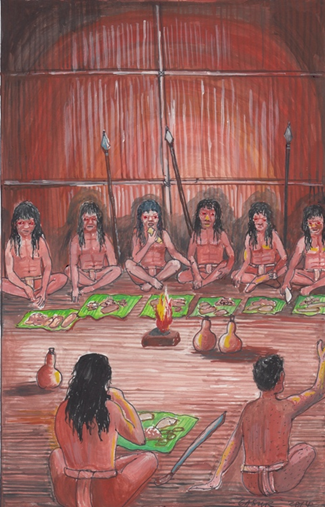
Figure 4. The Seven Bataks are intoxicated by the juice from a fruit squeezed into the dish served from the story of Bah Luj and the Seven Bataks. Used with permission from Pandak Basri Kana.
Soon, the seven Bataks grew drowsy and collapsed onto the wooden logs, which Bah Luj then set ablaze. He kills them and, through his magical powers, resurrects his wife and child. This story highlights how Semai masculinity is embodied not in brute force but in wit, wisdom and spiritual agency. Bah Luj defeats enemies far stronger than himself through cleverness, patience, and knowledge. By embodying these qualities, Bah Luj functions as an epitome of Semai masculinity and likely served as a role model for boys.
Conclusion
Unlike masculinities rooted in domination and patriarchal control, Semai masculinity—exemplified by the character Bah Luj—privileges cognitive ability, supernatural insight, and communal responsibility over physical strength or coercive authority.
Through Bah Luj, storytellers not only sustain Semai values but also resist and invert external systems of domination—whether the historical realities of slave trading or the pressures of contemporary assimilationist policies. Indigenous folktales often serve as vehicles for transmitting communal values, and stories about Bah Luj can similarly be revalorised to reflect the concerns of modern Semai society. Bah Luj’s supernatural powers, for instance, may be interpreted metaphorically as representing the multiple intelligences or unique talents of Semai individuals, especially those who are technologically adept. In contemporary society, the story of Bah Luj deceiving and defeating the Bataks can be reimagined as a reflection on how individuals navigate modern forms of deceit, such as online scams, and pursue justice through appropriate means. Gender roles have evolved and achieving balance between men and women need not entail adherence to traditional occupational divisions. Instead, it may be understood as the equitable sharing of responsibilities within marriage, family, and peer relationships. Likewise, wisdom and wit—central traits of Bah Luj—can be viewed as markers of holistic intelligence encompassing leadership, charisma, and emotional acumen, rather than academic success alone.
As living traditions, folktales continue to provide storytellers with a dynamic foundation to renew, reinterpret, and transmit cultural values in ways that remain relevant to the evolving social realities of the community.
[1] Chan, C. S. C., Edo, C., Loy, C. L., Nasrifan, M. N., & Sulong, M. A. (2016b). Bah Luj and the seven Bataks. Institute Terjemahan Buku Malaysia and Penerbit Universiti Pendidikan Sultan Idris.
[2] Chan, C. S. C., Edo, C., Loy, C. L., Nasrifan, M. N., & Sulong, M. A. (2016a). Bah Luj and the Garuda. Institute Terjemahan Buku Malaysia & Penerbit Universiti Pendidikan Sultan Idris.
[3] Chan, C. S. C., Edo, C., Loy, C. L., Nasrifan, M. N., & Sulong, M. A. (2016a). Bah Luj and the Garuda. Institute Terjemahan Buku Malaysia & Penerbit Universiti Pendidikan Sultan Idris.
[4] Chan, C. S. C., Edo, C., Loy, C. L., Nasrifan, M. N., & Sulong, M. A. (2016c). Bah Luj and the Evil Spirit. Institute Terjemahan Buku Malaysia and Penerbit Universiti Pendidikan Sultan Idris
[5] Chan, C. S. C., Edo, C., Loy, C. L., Nasrifan, M. N., & Sulong, M. A. (2016d). Bah Luj and his Five Brothers. Institute Terjemahan Buku Malaysia and Penerbit Universiti Pendidikan Sultan Idris
[6] Chan, C. S. C., Edo, C., Loy, C. L., Nasrifan, M. N., & Sulong, M. A. (2016c). Bah Luj and the Evil Spirit. Institute Terjemahan Buku Malaysia and Penerbit Universiti Pendidikan Sultan Idris.
Main image: A community pop band at Kampung Bukit Terang in Kampar, Perak, in 2017. Credit: Author.