Conflict between India and Pakistan shows how vital shared transboundary resources, such as water, can be placed at risk. This article calls for stronger institutional practices that can persist through geo-political tension.
Keywords: water governance, Indus Basin, Indus Water Treaty, India Pakistan, conflict transformation
India’s announcement in 2025 to suspend the Indus Waters Treaty (the Treaty) with Pakistan marks a critical point in South Asia’s transboundary water governance.
The Indus River Basin spans the Tibetan Plateau, India, and Pakistan, forming a transboundary hydrological system that underpins the agriculture and livelihoods of a vast population. The Treaty, signed by India and Pakistan, provides a framework for transboundary water sharing, and was regarded as one of the most successful international treaties. However, it has come under unprecedented strain since April 22, 2025, when Pakistan-based militants attacked a group of tourists at the Baisaran Valley meadow in India, killing 26 civilians and injuring more than 20. Among the most consequential moves was India’s announcement that it would hold the Treaty in abeyance.
The suspension of the decades old Treaty not only disrupts interstate cooperation but also reconfigures basin-level governance, socio-political relations, and the everyday water practices of communities across the Indus Basin.
In this article, we ask how the suspension of the Treaty reshapes social, political, and gendered dimensions of conflict, and how an intersectional approach could inform pathways for conflict transformation. We begin by offering an overview of the Treaty’s key features and its execution. We then briefly trace the geo-political fallout following the terror attack leading to the suspension of the treaty. Then, we turn the discussion to the implications of this sharp securitisation of transboundary water management on the ground through the lens of feminist ecology. We follow this with our argument against such securitisation and the justification for continued cooperation guided by the theoretical logic of progressive realism. Finally, we explore ways to mend the fractured water governance in the region.
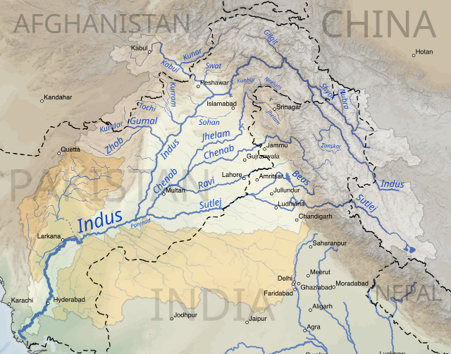
Figure 1: The Indus River Basin showing the course of the Indus River and its six major tributaries (Indus, Jhelum, Chenab, Ravi, Beas, and Sutlej), as well as key urban centres across China, India, Pakistan, and Afghanistan. Source: Adapted from Pepper (2018), Map of River Indus and Its Flow Through India Along with Its Tributaries, Wikimedia Commons. Available at: https://commons.wikimedia.org/w/index.php?curid=66085475.
The Indus Waters Treaty: A brief overview
Signed in 1960 with the World Bank’s facilitation, the Treaty has often been lauded as a landmark achievement in transboundary water governance. Negotiated over several years, it regulates the use of the Indus Basin rivers between India and Pakistan, two independent countries sharing an interconnected river system. The three eastern rivers—Ravi, Beas, and Sutlej—were allocated for unrestricted use by India. The three western rivers— Indus, Jhelum, and Chenab—were reserved primarily for Pakistan, while India retained limited rights for uses such as hydropower generation, navigation, and irrigation within specified limits.
The Treaty instituted a Permanent Indus Commission, with representatives from both countries mandated to meet regularly, exchange data, resolve disputes, and maintain dialogue. Dispute resolution mechanisms were built into the Treaty (Article IX), providing for technical negotiations, the appointment of a Neutral Expert, and international arbitration under the aegis of the World Bank. Remarkably, the Treaty has endured multiple wars, border skirmishes, and diplomatic breakdowns between India and Pakistan over the past six decades. It is often referred to as an example of ‘conflict management’ rather than ‘conflict resolution’, embodying a rare instance of institutionalised cooperation in a highly sensitive geopolitical region. Its endurance reflected a shared recognition of the Basin’s importance to agriculture, livelihoods, and regional stability. The Basin irrigates about 16 million hectares in Pakistan, around 80 percent of its arable land, and supports densely populated agricultural regions in both countries, notably the Indian states of Punjab and Jammu & Kashmir, and the Pakistani provinces of Punjab and Sindh. For these regions, the rivers are not merely flows of water; they are arteries of culture, economy, and survival.
The Basin’s ecology makes cooperation indispensable. The Indus derives between 50 and 80 per cent of its flow from Himalayan snow and glacier melt, while also depending on highly variable monsoon rainfall, creating marked seasonal fluctuations while sustaining one of the world’s largest contiguous irrigation systems. Emerging pressures, including glacier retreat, increasing frequency of floods and droughts, and saltwater intrusion in the Indus Delta, are further reshaping the Basin’s ecology. These conditions make river flows, storage, and flood management inherently transboundary, requiring institutions capable of governing an increasingly variable shared river system.
Although the physical flow of the rivers is unlikely to change in the short term,, the suspension of institutional cooperation has more immediate consequences. The Treaty enabled regular exchanges of hydrological data, discussions on infrastructure projects, and technical coordination through the Permanent Indus Commission, reducing uncertainty around river flows, reservoir operations, and flood forecasting. When such mechanisms are suspended or weakened, uncertainty increases for governments, water managers, and communities alike.
The Treaty is widely regarded as a landmark transboundary water governance and has informed broader scholarship on cooperation between politically adversarial riparian states. Critics, however, argue that its emphasis on river allocation reflects the priorities of the mid-twentieth century and is less equipped to address contemporary challenges such as climate change, groundwater depletion, environmental flows, and public participation. Even so, there is broad agreement that its institutional framework has enabled sustained technical cooperation through data sharing, dialogue, and dispute resolution.
Holding the Treaty in abeyance therefore raises important questions about the future allocation of water, the erosion of institutional arrangements that have facilitated peaceful transboundary water management for more than six decades, regional geopolitics and the livelihoods of millions who depend on the basin.
Water as a matter of conflict and security: The recent deterioration of relations between India and Pakistan
The events of April 2025 marked a significant shift in India-Pakistan water relations. Following the Pahalgam attack, India halted the exchange of hydrological data, cancelled meetings of the Permanent Indus Commission, and announced that it would maximise its use of the western rivers within the Treaty’s permissible technical limits. According to the government of India, the abeyance will remain in place ‘until Pakistan credibly and irrevocably abjures its support for cross-border terrorism’. This diplomatic withdrawal marks a significant departure from the Treaty’s established practice of institutional cooperation and information sharing, particularly because the Treaty does not explicitly provide for unilateral suspension.
Holding the Treaty in abeyance marks a significant shift in how water is framed within India-Pakistan relations. A statement by India’s Prime Minister Narendra Modi in 2016 that ‘blood and water cannot flow together’, and the subsequent statement by the Pakistan People’s Party Chairman Bilawal Bhutto-Zardari on April 25, 2025 – ‘Either our water will flow or their blood’ are indicative of how water is being reconfigured as an instrument of conflict and an exercise of sovereign power and contest. These statements illustrate how water is increasingly framed as an instrument of security and sovereign power rather than as a shared ecological resource.
Scholars such as Brahma Chellaney argue that upstream riparian states should treat water as a strategic resource central to national security. From this perspective, suspending cooperation under the Treaty represents an assertion of sovereign control in a geopolitically unstable region. A feminist political ecology perspective, however, shifts attention to who bears the costs of these decisions.
Gendered vulnerabilities
Within the Indus Basin, women’s daily lives are closely shaped by access to water for agriculture, livestock, household needs, sanitation, and care work. When rivers become politicised, the invisible labour of securing and managing water within households is among the first to be disrupted. Historical experiences of water stress in the region offer glimpses into what may lie ahead if the Treaty suspension is actualised. Reports show that, during the severe droughts of the early 2000s in Sindh and southern Punjab, women bore the disproportionate burden of securing water as traditional wells dried up and river flows diminished.
Evidence from water-insecure regions across the Global South also shows that women and girls disproportionately bear the burden of securing water, increasing their exposure to physical strain, health risks, and, in some settings, violence. Water scarcity also affects agricultural production, contributing to income insecurity among women engaged in informal rural work. Although these dynamics have not been systematically examined in relation to the current developments in the Indus Basin, they illustrate how disruptions in water governance can generate uneven social impacts.
Women have also developed collective water-sharing arrangements and household conservation practices that demonstrate agency, although these strategies have become increasingly difficult to sustain under growing environmental and geopolitical pressures.
These vulnerabilities are shaped by entrenched structures of gender, caste, and class. As political sociologist Shilpi Srivastava and others note, water governance in South Asia often frames communities as homogenous recipients of policy interventions rather than as socially complex actors with varying degrees of resilience and risk. The intersection of environmental disruption with militarisation further complicates these vulnerabilities. Past instances of resource disruption across South Asia demonstrate that changes in water access and control have contributed to displacement, localised conflict, and heightened insecurity. Research from Pakistan, Bangladesh, and Sri Lanka show that uneven access to water and contested irrigation regimes can intensify displacement, livelihood insecurity, and everyday conflict.
Everyday activities such as accessing water sources, visiting markets, or attending school can become fraught in militarised environments, disproportionately constraining women’s mobility and safety. As political scientist and feminist Cynthia Enloe reminds us, militarisation is not simply the presence of armed forces; it is a transformation of daily life, where domestic spaces, survival strategies, and bodies themselves become arenas of political struggle. Thus, when water systems become unstable, the consequences extend beyond agriculture or infrastructure to the gendered networks of care, mobility, and everyday survival that sustain communities.
Between security and survival: A progressive ethics for water governance
The language surrounding water governance in South Asia is increasingly framed in terms of security, sovereignty, and strategic rationality. This is especially evident in the aftermath of the Pahalgam attack. From a feminist political ecology perspective, such a framing produces complex ethical problems. Decisions to reroute, restrict, or reframe water flows extend far beyond diplomatic negotiations. They redistribute risks across society, disproportionately affecting women and other marginalised communities whose livelihoods depend on rivers, while decisions framed as protecting national interests may also generate new internal vulnerabilities.
The ethics of water governance demand that we look beyond the immediate logics of retaliation or control. As philosopher Nancy Fraser has emphasised, distributive justice must be considered alongside recognition justice: it is not enough to distribute resources efficiently; it matters whose voices, needs, and vulnerabilities are acknowledged in decision-making processes. In the Indus Basin, rural women, Indigenous communities, and marginalised castes are seldom represented in national discussions on river governance despite being among those most directly affected by changes in water regimes.
India is a signatory to the Sendai Framework for Disaster Risk Reduction (2015–2030), which calls for inclusive, people-centred disaster governance that recognises the disproportionate impacts of disasters on women and marginalised groups. Framing river management decisions as acts of national security without acknowledging their potential to create or intensify disaster risks runs counter to this global commitment.
Ethical river governance in an era of climate change requires recognising that political borders do not eliminate ecological interdependence or shared vulnerability. The foreign policy framework based on progressive realism provides one way of thinking about this challenge. It recognises states as central actors and accepts the persistence of geopolitical competition while acknowledging that power relations are shaped by social forces, including gender. Rather than treating cooperation as an ethical end in itself, it views transboundary institutions and cooperation as practical and necessary mechanisms for managing shared ecological risks despite continuing political disagreement. Conflict transformation, in this view, seeks not to eliminate disagreement but to reduce uneven vulnerabilities while preserving functional cooperation.
How could governance in the Indus Basin be improved?
Achieving these objectives will require institutional measures that can remain functional even when broader diplomatic relations are strained. One practical step would be to preserve technical communication through the Permanent Indus Commission, allowing routine exchanges on river flows, infrastructure maintenance, and seasonal forecasts to continue irrespective of political developments. A second priority is to strengthen Basin-wide mechanisms for joint flood forecasting and early warning, particularly as climate variability increases the frequency of hydrological extremes. These systems are most effective when supported by timely data sharing and coordinated technical assessments. Governance can also be broadened beyond interstate institutions by creating structured opportunities for consultation with state governments, local water managers, researchers, and civil society organisations working within the Basin. Such engagement would incorporate local knowledge while making the differentiated impacts of water governance more visible.
These measures do not resolve any structural tensions that shape India-Pakistan relations. However, they do point toward forms of institutional continuity that recognise the material limits of unilateral control over shared ecological systems. Such arrangements cannot eliminate political tensions, but they can reduce the uneven harms generated within a shared ecological system.
Authors: D. Saran Prakash and A/Prof. Robert Mizo.
Image: River Zanskar, a major left-bank tributary of the Indus River system, June, 2017. Used with permission: Robert Mizo.