Myanmar’s federal future will depend on sub-state legitimacy, not just national-level recognition or battlefield success.
Keywords: Myanmar, political legitimacy, federal democratic union, military coup.
Myanmar’s struggle against military rule is also a struggle over legitimacy: Who has the right to govern, represent people, administer territory and design a future union.
The military junta seized the state in February 2021 and claimed to act under the 2008 Constitution crafted by the previous military regime. Unlike the previous coups in 1962 and 1988, the question of authority was not settled in the 2021 coup—it exacerbated long-standing contestation between coercive control and accepted rule across the country. The military later tried to renew its claim through a military-managed election and a civilian-looking presidency.
The resistance movement, recognising a lack of unity and cohesion among those opposing military rule, attempted to build a different claim through various bodies, although all have limitations to their legitimacy (more on that later):
- The Committee Representing Pyidaungsu Hluttaw (CRPH)—a legislative body mainly made up of National League for Democracy lawmakers and a small number of other MPs.
- The National Unity Government (NUG)—a provisional government formed by the CRPH.
- Broader coordination through the National Unity Consultative Council (NUCC) )—an advisory body to the National Unity Government.
- A federal democratic future through the Federal Democracy Charter (FDC)
- Practical authority in areas not controlled by the junta.
This article argues that the newest body, the Steering Council for the Emergence of a Federal Democratic Union (SCEF), formed in 2026, moves this legitimacy contest to the sub-state level. SCEF does not only ask which actors oppose the military. It asks which actors have territory, administration, federal commitment and willingness to cooperate to become future federal constituent authorities. SCEF therefore turns an old revolutionary idea, the united front, into a more demanding test of sub-state legitimacy. (This article does not address negotiations occurring before the coup.)
Legitimacy is more than control
The theoretical point is simple but important: legitimacy is not the same as power. International affairs scholar Robert Keohane’s distinction between normative legitimacy, whether an authority has the right to rule; and sociological legitimacy, whether people believe it has that right, shows that legitimacy depends not only on claims to authority but on acceptance by relevant constituencies. Empirical work on legitimacy in fragile states likewise emphasises that legitimacy is conferred by those subject to an authority, and rests on their beliefs, perceptions and expectations. In plural and divided contexts, acceptance is often partial and contested: different groups may recognise different authorities, so an institution can be legitimate for some while rejected by others. Philosopher Furio Cerutti’s distinction between a legitimacy claim from a legitimacy belief makes the political implication explicit: a ruler or institution can claim legitimacy, but that assertion has political effect only when people accept it.
In revolutionary settings, legitimacy is often plural. One actor may control ministries; another may carry an electoral mandate; and yet another may protect a community or administer a territory. The important question is not only which claim exists, but how different claims can be joined without one erasing the others.
Federal constituent legitimacy recognises the right of a territorially embedded political actor to represent, administer and help constitute a future state or federal unit within a Federal Democratic Union. Unlike conventional rebel legitimacy, it is not secured by armed resistance, territorial control or popular appeal alone. Federal constituent legitimacy also requires demonstrable administrative capacity, meaningful acceptance by the affected communities, and a genuine commitment to shared federal rules and institutions.
These distinctions help to explain Myanmar’s post-coup politics. The military junta possesses guns, ministries and state buildings, but coercive control does not translate to rightful authority. The CRPH (the legislative body representing a group of National League for Democracy lawmakers and MPs) and the National Unity Government carried the democratic mandate from the 2020 election, but that mandate alone could not deliver governance in every area or substitute for locally embedded resistance sources of authority. Ethnic revolutionary organisations (EROs) have another form of authority, grounded in territorial control, administrative mechanisms and institutions, long histories of resistance and community support.
SCEF is important because it tries to bring these different sources of legitimacy into one federal framework—navigating which actors have the territorial reach, administrative capacity, communal acceptance and commitment to shared federal rules required to become federal constituent authorities.
The 2021 coup and the constitutional problem
The 2021 military coup was different from previous coups in Myanmar. It happened just before the newly elected parliament was due to convene. Elected MPs, civil servants, protesters, ethnic organisations and, later, armed resistance groups quickly rejected the military’s claim to rule. The coup therefore produced what can be called a revolutionary legitimacy crisis: multiple claims to the right to speak for the state and the people.
The military’s legal claim was weak. The 2008 Constitution states that sovereign power is derived from citizens and that the President is the head of the Union and the Union executive. For the military to arrest the President, create a vacancy and then use that altered situation to transfer power to itself was unconstitutional.
The gap between constitutional language and military action underpins a central claim of those opposing the military: The military may have captured the state, but people refused to treat the coup as a legitimate transfer of power repeating political patterns of earlier military takeovers. The military could exercise coercion, but it faced an immediate counterclaim from elected representatives and people across society who refused to treat the takeover as a normal transfer of authority.
The first post-coup political bodies: CRPH, FDC, NUCC and NUG
Post-coup political groupings included newly elected representatives, civil society, protest movements and a range of local authorities who responded quickly to maintain and adapt governance arrangements.
The Committee Representing Pyidaungsu Hluttaw (CRPH) claimed the 2020 general election had more than 71 percent voter participation, a figure backed up by the International Foundation for Electoral Systems; and the election was recognised as credible by local and international observers. A group of 298 parliamentarians met online on 5 February 2021 to form the CRPH, with 398 MPs in total authorising its formation and powers. In practice, the CRPH consists of 20 elected MPs, who were authorised by the total number of parliamentarians to carry forward the work of the CRPH. CRPH framed itself as having a democratic mandate, but it has been criticised for comprising mostly National League for Democracy politicians and not incorporating broad representation for ethnic political parties.
CRPH then moved to political reconstruction. Its early political vision called for ending military dictatorship, releasing unlawfully detained leaders, achieving full democracy, rescinding the 2008 Constitution and writing a new federal constitution. The Federal Democracy Charter became the clearest statement of this wider project. Part I declared the goals of a Federal Democratic Union and Part II set out interim constitutional arrangements. This mattered because resistance actors are not only trying to restore the pre-coup order; they are also trying to build a new political settlement that could include elected representatives, ethnic revolutionary organisations, civil society, federal-unit bodies and communities living outside military control.
The National Unity Consultative Council (NUCC), the advisory body to the National Unity Government, attempted to broaden this claim from a parliamentary response into a wider revolutionary process. Its membership framework includes elected representatives, political parties, civil society organisations, women’s and youth organisations, ethnic revolutionary organisations and interim state or federal-unit bodies. The National Unity Government then gave these resistance actors a governmental form.
There have been challenges and criticisms, such as uneven territorial and administrative reach, limited material and diplomatic resources, and recurring coordination problems between actors with different priorities; and some ethnic organisations and local authorities have contested aspects of representation and decision‑making. The NUCC’s guidelines stated that the People Assembly was mandated to convene every six months, but it has only met twice in five years. The NUG has established institutional and administrative structures intended to support a functioning central authority, but their operational capacity and effectiveness remain uneven across the areas under its administration. It has therefore not yet been able to meet all the needs of local resistance actors in those areas.
Why electoral legitimacy was not enough
Myanmar’s revolution is wider than the 2020 vote. Many ethnic revolutionary organisations did not derive their authority from that election. Their legitimacy comes from other sources: decades of armed resistance, defence of communities, control of territory, service delivery and local administration. In many ethnic minority areas, these organisations had already acted as governing authorities long before the coup.
Research on de facto states is useful here. It shows that authorities which lack full external recognition often depend heavily on internal legitimacy: whether people believe in the entity, the regime and its institutions. Research on rebel governance adds a warning. Wartime administration can provide material for future state-building, but it can also be fragmented, borrowed from local leaders or humanitarian actors, or weakly institutionalised. Research on areas of limited statehood also shows that places with weak formal state institutions are not necessarily ungoverned; rules and services may come from informal and non-state actors.
This creates a central challenge for Myanmar. Electoral legitimacy without territorial and administrative reach can remain distant from many communities. Territorial control without a federal democratic framework can (re)produce fragmentation. A future federal union needs both self-rule and shared rule. It must recognise the plurality of local authority while also building common institutions. Constitutional theorist Stephen Tierney’s work on sub-state national societies helps frame this point: in multinational settings, sovereignty is not only a relationship between one people and one state, but a relationship among multiple peoples and a shared state.
SCEF’s federal constituent test
By late 2025 and early 2026, the legitimacy struggle entered a new phase when the military held elections in December and January. Following the elections the military-backed Union Solidarity and Development Party and the constitutionally reserved military seats together controlled about 86 percent of parliament. In April 2026, Min Aung Hlaing was elected president by a pro-military parliament, a move widely seen as a civilian-looking continuation of military power.
In the same period, the CRPH, the National Unity Government, the Chin National Front, the Kachin Independent Organisation, the Karenni People’s Progress Party and the Karen National Union formed SCEF (the Steering Council for the Emergence of a Federal Democratic Union), aiming to make it a unifying body capable of dismantling the dictatorship and beginning a new political landscape. Its membership subsequently expanded on 8 September 2026, when the Sagaing, Magway and Mandalay Federal Units were formally admitted, bringing the council’s membership to nine organisations.
SCEF draws on earlier revolutionary bodies in Myanmar, but its innovation lies in applying sub-state legitimacy criteria that are sensitive to the shifting territorial and contested authorities of dynamic conflict systems. Where a conventional united front usually asks who can stand together against a common enemy, SCEF asks a harder question: Which actors can function as political units within a future federal order? This makes SCEF both a filtering mechanism as well as an alliance-building mechanism. It brings together the National Unity Government, the CRPH and key ethnic revolutionary allies from Kachin, Karen, Karenni and Chin movements beyond simply alliance-building. It asks which actors can credibly become federal constituent authorities demonstrating territorial embeddedness linking claims to representation and administrative capacity, communal acceptance and commitment to shared federal rules.
‘Federal constituent authorities’ refers to the bodies that would represent and govern the states or federal units making up a future Federal Democratic Union. This article reads SCEF’s membership criteria as a test of whether an organisation has a credible claim to such a role, based on its relationship with communities, its governing capacity and its commitment to shared federal rules. The four criteria therefore raise the following questions of legitimacy:
- Territory asks whether an actor is grounded in a real political community and place. Territory is not just a military map; it is a relationship with people who live there.
- Administration asks whether authority is practised through public functions such as security, justice, education, health, taxation, humanitarian coordination or dispute resolution. This is the output side of legitimacy: what an authority actually does.
- Federal commitment asks whether an actor accepts the principles of a Federal Democratic Union. This is the normative test: authority must be tied to constitutional principles, not only to armed struggle.
- Cooperation asks whether actors are willing to work within a nationwide framework and requires capacity to negotiate and sustain intergovernmental relations. This is the federal test: self-rule must be linked to shared rule.
The question is no longer only who fought the military, but who has the territory, administration, federal commitment and commitment to shared rule. SCEF’s importance is therefore not only that it coordinates resistance. While it may convert territorially embedded organisations from armed or ethnic revolutionary actors into possible federal constituent authorities, it will need to reimagine and transform ways of engaging with new sub-union administrative formations to avoid the legacies of the past.
The unresolved challenges
There is legitimate concern about whether SCEF will be able to avoid reproducing the inequalities and exclusionary practices of the past. SCEF has largely been formed through top-down processes and has limited engagement with the people as to what a federal democracy might look like. Additionally, SCEF has so far not proposed moving beyond the longstanding administrative structure of seven regions and seven states, a legacy of British colonial rule which exacerbated ethnic division. Whether smaller, upland and linguistically diverse communities can meaningfully shape territorial arrangements and exercise self-government remains unknown.
SCEF offers a clearer pathway to identify future federal constituent actors, but four interrelated challenges are especially important in practice.
- Claims of territory, administration, federal commitment and cooperation need evidence. A group may say it governs an area, but SCEF still has to ask who provides services, who resolves disputes, who is accountable to civilians and whether communities recognise that authority.
- Mixed control. In many areas, ethnic revolutionary organisations, People’s Defence Forces, NUG-linked administrations, local defence forces, civil society groups and community leaders share authority. Areas outside military control are not automatically controlled by one resistance actor.
- SCEF’s criteria may favour state, federal unit and ethnic revolutionary organisation (ERO) actors that exercise territorial control, provide public services and maintain administrative structures, while demonstrating a commitment to a federal democratic union and a willingness to cooperate. SCEF also needs to support its members in strengthening social inclusion, civic participation and meaningful representation, particularly for women, youth, displaced people, smaller ethnic communities, and other historically excluded groups. Strengthening these practices within political and administrative bodies would help ensure that institutional capacity is accompanied by community participation and recognition, reinforcing the sociological legitimacy of SCEF’s members.
- Finally, recognition within SCEF of federal constituent actors may acknowledge existing local legitimacy but does not imply uniform or permanent acceptance of an actor’s authority. SCEF provides a procedural pathway for considering federal constituent claims. But the scope and continuity of each actor’s representative mandate still depends on ongoing community recognition, participation and accountability. Legitimacy is therefore a continuing relationship, not a status conclusively secured through admission to SCEF.
Conclusion: From resistance-related legitimacy to federal authority
SCEF is the latest stage of a five-year struggle since the military coup to form a legitimate political opposition. It is significant because it shows how legitimacy is encountered across levels: from national electoral mandate to revolutionary coordination, to sub-state constituent authority. Myanmar’s federal future will not be decided only by national-level recognition or battlefield success. It will also depend on sub-state legitimacy: whether future federal units can show territorial grounding, practical administration, federal commitment, cooperation and public acceptance. SCEF may not settle these questions, but it makes them unavoidable. The struggle is now not only over who governs the country, but over how a future federal union decides who has the right to govern at all.
Authors:
Dr Tun Aung Shwe has served as the National Unity Government of Myanmar’s Representative to Australia since July 2021 and is a PhD candidate at UNSW. He holds master’s degrees in public health and health management from UNSW Sydney and in development studies from the Institute of Economics, Yangon. His research and professional work span social cohesion, peacebuilding and governance.
Dr Tania Miletic is the Co-Director of the University of Melbourne’s Initiative for Peacebuilding within the Arts Faculty, working to promote multidisciplinary research, teaching and policy development that supports effective engagement in conflict prevention and peacebuilding in the Asia and Pacific region.
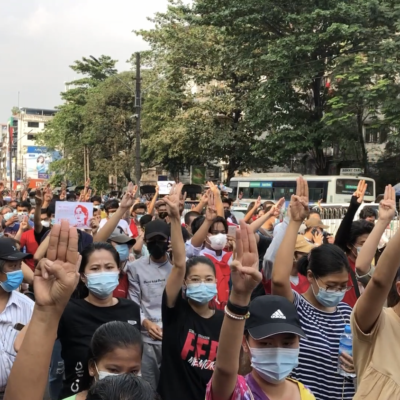
Image: A crowd of people protesting against the military coup on a Yangon street, 2021. Credit: Saw Wanna/Unsplash.