Teaser words: The future of Rakhine State, the site of ongoing persecution against the Rohingya people, will not only depend only on who controls territory, but on whether Arakan authorities can build a political order that is protective and inclusive.
Key words: Arakan authorities, Rakhine State, Myanmar, Rohingya, minorities, legitimacy.
Since the 2021 military coup in Myanmar, the Arakan Army and its political wing, the United League of Arakan, have significantly expanded their territorial control and governing authority in Rakhine State. The question is therefore whether Arakan authorities can build legitimacy across diverse communities whose political interests, identities and experiences of conflict differ significantly.
This article argues that the legitimacy of Arakan authorities will depend on how effectively they govern and whether the communities living under their rule experience that authority as fair, protective and politically inclusive. Their legitimacy will remain partial unless Rohingya and other minorities are recognised as equal members in Arakan’s political community, protected from human rights abuses and exploitation, and given a meaningful role in determining their political future.
Background
The Arakan Army is a Rakhine armed organisation founded in 2009 to pursue greater self-determination. The Rakhine people are the predominantly Buddhist majority in Rakhine State, a multi-ethnic region in western Myanmar that the Arakan Army and many communities refer to as Arakan. The region is also home to Rohingya Muslims and smaller ethnic communities, including Kaman, Mro, Thet, Khami, Maramagyi and Daingnet. Rakhine state is one of Myanmar’s poorest regions and has long been affected by economic neglect, militarisation and armed conflict.
Rohingya communities have faced decades of severe persecution, including during the Myanmar military’s 2017 campaign of violence and mass displacement and more recent allegations and evidence of killings, forced displacement, arbitrary arrest, gender based violence, enforced disappearance and destruction of villages by members of the Arakan Army, reported by the UN High Commissioner for Refugees and other credible organisations. Rakhine and other communities have also experienced violence, displacement and political marginalisation.
The Arakan Army became a major armed group during the conflict with the Myanmar military from 2018 to 2020. Alongside military gains, the Arakan Army and the United League of Arakan developed parallel governing institutions. The Arakan People’s Authority, established in late 2019, has since expanded to oversee security, taxation, dispute resolution, courts, local administration and other aspects of everyday life. This reflects a broader effort to establish a new political order in Rakhine State. As this governing authority has expanded, the question of legitimacy has become increasingly important.
Legitimacy in Rakhine State
Political theorist David Beetham argues that power is legitimate when it follows rules, can be justified through shared beliefs and receives recognisable consent. Sociologist Morris Zelditch similarly writes that authority is legitimate when it accords with the norms, values, beliefs, practices and procedures accepted by a group. In a multi-ethnic region such as Rakhine State, Arakan authorities cannot rely on legitimacy among Rakhine communities alone because they govern Rohingya and other communities as well. As Sukanya Podder’s relational approach to armed-group legitimacy suggests, legitimacy depends on the relationship between an armed group and the communities it governs. Different communities may therefore judge Arakan authorities according to different experiences and expectations.
In post-coup Rakhine State, claims to legitimacy draw on several sources, including military success, governance and justice, protection, Rakhine self-determination, and the inclusion of Rohingya and other minority communities. Legitimacy therefore concerns whether these varied communities regard the rule of Arakan authorities as rightful and appropriate.
My analysis draws on qualitative fieldwork conducted in 2023 and follow-up interviews and discussions through 2025. The research included 58 interviews, alongside informal discussions with Rakhine, Rohingya and other minority communities, as well as civil society actors and political leaders connected to Rakhine State. Interviewees included members of civil society organisations, representatives of political parties and community members from different ethnic and religious backgrounds. Questions explored their experiences of conflict and insecurity, their understandings of peace, and their relationships with governing authorities, including how they assessed opportunities for participation and the treatment of different communities. These conversations provide insight into how different communities experience and assess the changing political order under Arakan authorities.
From armed movement to governance
Ceasefire periods between 2020 and 2023 provided the Arakan Army and the United League of Arakan with greater space to strengthen their military capacity and expand governing institutions.
On 8 February 2024, the Arakan Army captured the military junta’s final remaining outpost in Mrauk U, the historic capital of the former Arakan kingdom. Mrauk U carries deep symbolic meaning for many Rakhine people because it recalls a period of Arakan sovereignty before the kingdom was conquered by the Burmese Konbaung dynasty in 1785.
By early 2026, the Arakan Army controlled 14 of Rakhine State’s 17 townships, alongside Paletwa Township in neighbouring Chin State. It had defeated major Myanmar military positions, taken key towns and expanded its authority across much of Rakhine State. No earlier Rakhine armed organisation had built military and administrative authority on this scale.
For many Rakhine people, these gains represent political liberation and collective dignity. The Arakan Army’s battlefield victories appear to reverse long-standing power relations between Rakhine communities and a central state widely regarded as violent, distant and dominated by the Bamar political and military elites. This has strengthened the Arakan Army’s claim to represent a credible political alternative to Myanmar’s central state.
Territorial gains have also enabled the Arakan Army and the United League of Arakan to bring its authority into civilian life. Local administrators work with village committees and community leaders on taxation, land matters, dispute resolution, criminal investigations and the regulation of everyday activities. Arakan authorities are therefore increasingly encountered not only through armed fighters, but through administrators, police officers, tax collectors and other officials.
As political scientist Zachariah Mampilly argues in ‘Rebel Rulers’ armed leaders seek legitimacy among civilian populations not only to sustain armed struggle, but also to build alternative systems of authority. The governing structures of Arakan authorities are part of this effort to turn military control into a political order embedded in local institutions and everyday relationships. Their legitimacy depends on whether communities see these structures as serving public need beyond armed control.
The administration of justice provides one important example.
By August 2021, the United League of Arakan had announced its own judiciary in rural areas and the system expanded rapidly. By February 2022, nearly 80 percent of judicial disputes were reportedly being resolved through the United League of Arakan courts. These courts have been viewed by many residents as more accessible, affordable and effective than Myanmar state courts. This can strengthen the claim of Arakan authorities to provide a more responsive form of rule.
High levels of court use, however, do not mean that people regard the system as legitimate. In some areas, the decline of Myanmar state institutions has left residents with few alternatives. A Rohingya interviewee from Maungdaw described approaching United League of Arakan institutions because other mechanisms were no longer functioning, while also noting that Rohingya residents feared the Arakan Army.
The legitimacy of the justice system therefore depends on more than accessibility or efficiency. Tom Tyler’s work on procedural justice emphasises that people are more likely to accept authority voluntarily when they regard it as appropriate, fair and just. Compliance based on fear or punishment does not indicate legitimacy. People also judge whether rules are predictable, decisions are consistent, officials are accountable and different communities are treated fairly.
These questions are significant in the Arakan justice system. Participants in this research expressed concerns about accountability, particularly when disputes involved Arakan officials themselves. Similar concerns appear in a 2024 Center for Arakan Studies report, which documents nepotism, favouritism, corruption and inconsistencies in case handling. The report also raised questions about judicial independence in disputes involving civilians and Arakan civil servants, including cases in which victims’ families were reluctant to file complaints.
Cases involving deaths in custody provide further examples of these concerns. A report by the Center for Arakan studies documents two cases in 2022 and 2023 in which detainees died following interrogation or detention by United League of Arakan personnel, generating public criticism and demands for accountability. Justice can strength legitimacy when it provides accessible and responsive governance, but this depends on whether authority is also exercised fairly and whether officials themselves can be held accountable.
Taxation also raises questions about legitimacy
Interviews with Rohingya and other minority groups described paying taxes to both the Arakan Army and the Myanmar military because they felt they had little choice. In some areas, Rohingya households were expected to contribute to the United League of Arakan in cash or rice while also paying taxes to the Myanmar military, placing families under overlapping financial and political pressure. Residents could face threats from the military for engaging with Arakan authorities while also feeling obligated to meet the taxation requirements of Arakan authorities. These payments were not associated with receiving public services or recognising either actor as legitimate. The ability to collect taxes can therefore demonstrate control and produce compliance without producing legitimacy.
As political scientist Stathis Kalyvas argues, ‘fear alone does not suffice to sustain rule in the long term.’ For Arakan authorities, the ability to secure payment is therefore not the same as securing political acceptance.
Territorial control, justice and taxation show different dimensions of Arakan authorities’ expanding rule. Military victories provide the territorial basis for authority, courts bring that authority into everyday governance, and taxation demonstrates the capacity to make demands on populations. None of these alone establishes legitimacy. As international relations scholars Klaus Schlichte and Ulrich Schneckener argue, armed groups must build and maintain legitimacy among the different communities they seek to govern. Therefore, the question is whether communities regard Arakan authorities’ rule as rightful.
Rakhine nationalism and legitimacy
Rakhine nationalism gives the authority of the Arakan Army and the United League of Arakan a broader political and moral meaning. It enables them to present their rule as part of a political project centred on self-determination, the recovery of political agency and the restoration of collective dignity.
The project draws on a longer Rakhine history of political marginalisation, economic hardship and frustration with rule from Myanmar’s central state. For many Rakhine people, successive governments gave them little influence over decisions affecting their land, resources and political representation. Arakan authorities have turned these grievances into a political ideology through the ‘Way of Rakhita’, often described as the ‘Arakan Dream’, which articulates national liberation and the restoration of Arakan sovereignty.
For many Rakhine supporters, this project also carries a moral claim. Experiences of political exclusion, military violence and the loss of sovereignty are viewed through ideas of historical injustice and collective dignity. The idea that Rakhine State should be governed by its own people connects self-determination with political autonomy, the recovery of dignity and a response to a long history of political subordination.
Nationalism scholar Anthony D. Smith argues that national identities are sustained through shared myths, memories and symbols. References to the former Arakan kingdom, lost sovereignty and collective dignity give political and moral meaning to contemporary Rakhine self-determination.
These narratives are increasingly being incorporated into governance. In 2026, Arakan authorities began preparing to restore historical names to towns including Pauktaw and Minbya, drawing on names associated with earlier Arakan Kingdoms. The United League of Arakan has also expanded the institutional use of the Rakhine language. In the 2026-2027 academic year, Rakhine became available as a Grade 12 subject while also being used in official administration. Burmese history was reportedly removed from the curriculum in 2024, while some schools in areas under Arakan Army control have begun teaching Rakhine history.
These practices give self-determination a more concrete form. Historical memory becomes attached to territory, while language and education connect everyday governance with a distinct Rakhine political identity. As David Beetham argues, authority is stronger when it can be justified through beliefs shared by those who rule and those who are ruled. For many Rakhine supporters, these practices reinforce the idea that Arakan authorities are restoring a political order regarded as both rightful and their own.
The appeal of Arakan authorities is therefore connected to a moral and political narrative of historical justice, collective dignity and national liberation. At the same time, placing Rakhine history, language and identity at the centre of this emerging order raises questions about the political place of Rohingya and other minority communities.
The limits of nationalist legitimacy: Unequal political belonging
For Rohingya and other minorities, political belonging within this emerging order remains uncertain. This is particularly important because human rights groups such as Amnesty International and Human Rights Watch have gathered evidence of human rights abuses of Rohingya and other minorities in areas under Arakan Army control, including a mass killing, forced labour, forced recruitment, arbitrary detention and other abuses, and restrictions on movement and livelihoods. These experiences undermine claims that Arakan authorities can provide protection and equal political belonging across communities.
Arakan authorities present the ‘Arakan Dream’ as a political project for all people living in Arakan. They have promised ‘freedom, democracy, social justice and welfare, and human dignity for all inhabitants in Arakan’. This ‘inclusive’ claim exists alongside expectations that minority communities demonstrate loyalty and participate in a shared struggle for liberation led by the Rakhine movement. Political belonging is therefore offered through a nationalist project whose central narrative has largely been defined by Rakhine history and aspirations.
They have been some openings for minority participation. Between 2021 and early 2023, restrictions on movement were relaxed in some areas under Arakan Army control, and some Rohingya were appointed to village-level administrative roles. Rohingya have joined village committees, received training as police personnel and health workers, and worked in humanitarian departments supporting displaced communities. Muslim Affairs Committees have also brought together religious leaders, village leaders and educated youth to address religious and social matters, taxation and land issues, maintain household records, and communicate with the Arakan-led administration.
These arrangements created practical channels for engagement, but they remain limited and uneven. Most Rohingya participation is concentrated at village or township level, while broader questions concerning identity, security, legal status, representation and Arakan’s political future remain largely beyond their influence. Minority communities can be incorporated into everyday governance without gaining meaningful recognition or a significant role in defining the political order.
As international relations scholar Jürgen Haacke argues, recognition is closely connected to legitimacy. Political belonging involves more than participation in administrative structures. It also concerns whether communities see their identity, rights and political status recognised within the wider political order. Where that recognition remains limited, participation may not translate into legitimacy. For Arakan authorities, building legitimacy beyond the core Rakhine constituency therefore requires recognition of Rohingya and other minorities as equal members of Arakan’s political community.
The legitimacy dilemma
Arakan authorities draw legitimacy from military success, historical grievances, self-determination and governing performance. But these sources are not enough to sustain legitimate governance across a multi-ethnic territory. Governing also requires accountability, civilian protection, and fair treatment of all. Commitments to inclusion must be reflected in how Rohingya and other monitories are treated, represented and recognised within the political order.
The future of Arakan’s political order will therefore depend not only on who controls territory, but on whether the Arakan authorities can build institutions that all communities experience as fair, protective and inclusive. Without meaningful recognition and political participation for Rohingya and other minorities, Arakan authorities may strengthen their control without securing broader legitimacy.
The author does not have any relevant political affiliations.
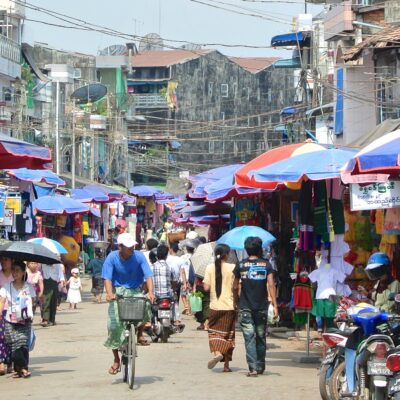
Image: A street scene in Sittwe, Myanmar, 2009. Credit: Jason Tabarias/Flickr.