Her Excellency Daw Zin Mar Aung is the Minister of Foreign Affairs for the National Unity Government, Myanmar.
She was a pro-democracy activist as a young person in the 1980s and 90s, which resulted in being sentenced to a 28-year prison term by a military court. She was released after 11 years, nine of which were in solitary confinement.
In 2012, she was internationally recognised, being awarded the International Women of Courage award by the then US Secretary of State Hilary Clinton.
She was elected a member of parliament in Myanmar in 2015 and was general secretary of the central women committee of the National League for Democracy, the democratically elected ruling party, until the military coup in 2021.
She spoke with Melbourne Asia Review’s Managing Editor, Cathy Harper.
This interview is part of a special edition on political legitimacy in Myanmar. Each article presents different perspectives and interpretations of legitimacy, and acknowledge its contestation, both practically and theoretically. So, I’m interested in what you think ‘legitimacy’ means in contemporary Myanmar.
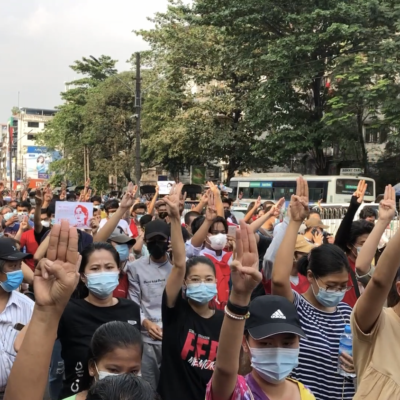
In Myanmar legitimacy is practical. We maintain that political legitimacy comes directly from the free and fair elections in 2020, which were credible and legitimate and recognised as such by international observers. But we don’t stop there, we are trying to advance our legitimacy. The people gave us a democratic mandate in 2020 and after the military coup in February 2021 people across the country asserted their right to reject military rule. It’s very clear that they are shaping a different political future. That’s why, today, legitimacy must also be earned through inclusive decision-making, especially in a country such as Myanmar with diverse ethnic groups. We must also address what’s really happening on the ground in areas under our control during conflict, such as the protection of civilians, accountable government and building a credible path to transition to a federal democratic union which is very important to us.
Who else you think has legitimacy in Myanmar over and above the group of lawmakers who were ousted after the coup. Who do you think has legitimacy and why?
It depends on how you look at it. From our point of view, it is very clear that in terms of democratic principles, legitimacy comes from the people and the elections. This gives us an electoral mandate which is a starting point to a claim of legitimacy. That is why even military junta tried to hold sham elections, even though they are not credible.
An electoral mandate carries a responsibility, in our case, to change the system. We are a legitimate representative of the people, but we are also trying to make ourselves responsible agents for change. Legitimacy must be renewed in practice. That’s why, in what we call the ‘revolution’, we started through the Committee Representing Pyidaungsu Hluttaw and consolidated with the National Unity Consultative Council and then National Unity Government. Now we trying to advance inclusivity and leadership for change. A few months ago, we formed the SCEF, the Steering Council for the Emergence of a Federal Democratic Union. The mandate that we carry is responsibility to change the system. This is another step in renewed legitimacy in practice to bring system change in Burma.
Legitimacy ultimately rests with the people. Alongside electoral mandates, it can grow from historical struggles for self-determination, community recognition, protection of rights and responsive governance.
Federal Units are strengthening legitimacy through public services, civilian protection and more inclusive institutions, despite extremely difficult conditions. Progress is uneven, however, and territorial control alone cannot establish a right to govern. People must also be able to participate, question decisions and hold authorities accountable, including women, youth, displaced people and smaller ethnic communities.
Building a federal democratic union requires recognising these locally rooted sources of legitimacy while strengthening inclusion and accountability. This responsibility applies equally to sub-state authorities and the National Unity Government: legitimacy must be continually earned and renewed.
How specifically does the SCEF plan to do all this very difficult work of providing for inclusivity and accountability?
The formation of SCEF is not just a statement—we are trying to advance what is happening on the ground. We need responsible leadership to form a federal democratic union. We’ve started to consult with ethnic alliances to advance collective leadership and prepare for a political transition. We’re not waiting for the military junta or other actors to make change—we’re trying to implement change ourselves.
The SCEF is made up of three pillars: the first pillar is representing the people based on the 2020 election result. The second pillar is the federal units and the Ethnic Resistance Organisations (EROs) that represent states and federal units. Another pillar is the women—this is unique and is not just about principles, it’s about how we can have affirmative action. Then there three layers: the first is the Leadership Council, which has the highest accountability, led by the chairperson of every organisation, such as the National Unity Government, the Prime Minister, Vice President, the chairperson of the Committee Representing Pyidaungsu Hluttaw, ERO chairmanships, such as the KIO chair, Karenni National Progressive Party chair, the Chin National Front chair, and the Karen National Union chair. This is the Leadership Council and the leaders within it have decision-making power. The second layer is the Secretariat, the operational level, which aims to find a way to cooperate without undermining every institution’s existing work. The Secretariat has two representatives from each organisation and we co-operate on daily activities, for example, discussions about political frameworks. The third layer is the Working Committee with four key areas: foreign affairs; finance and investment; the federalisation process; and security and defence. We also need to work together strategically in relation to military means. That’s why there is a Military Coordination Council and a kind of initial Joint Chief of Staff (this hasn’t yet happened, but we have initiated it). The Military Council has already been formed and they directly report to the Leadership Council. This is the working and operating structure of the SCEF. This is the difference. We realise we have the responsibility to bring change; and to address the root causes of our country’s long-term historical grievances in order to bring more inclusivity, even during the time of this crisis.
We are also open for others not yet ready to be part of this transition. We need a bloc that can be a stepping stone to the future transition. Some entities are trying to control their territory and their populations and legitimacy comes partly from who has control on the ground. SCEF is a little bit different in that we are not just trying to control territory, but we are also trying to prepare for political legitimacy and a political way out. Some bodies do not object to what we have been doing, they endorse it and welcome it, but they are not ready yet to be part of this meaningfully.
Who makes the decision as to when someone is ready and on what basis?
The idea comes from the combination of the concepts of de jure legitimacy and de facto legitimacy coming together in practice. Our criteria are for those who believe in the federal democratic union and in the future democracy, a democratic political system in the form of states as part of a federal state. We welcome those who believe in a federal democratic system and those who can represent the people in a territory on the ground. There are territorial disputes in some areas, but we have agreed that we will not resolve this kind of disputes through struggle—it must be resolved in a political way. So that’s why we have formed the federal Working Groups to nurture a culture of political dialogue, to set up a dispute mechanism in a federal democratic setting. That is the basic requirement to becoming a SCEF member.
It’s a very difficult task, isn’t it, to have real inclusivity for, for example, the Rohingya, as well as groups such as the Arakan Army or the Wa?
Of course, I agree with that. Even for the National Unity Government it’s very clear that Rohingya will be part of our community and must be. So that is why we issued a Statement in 2021 on the Rohingya minorities. We also need to consult with other ethnic groups and minorities to form the federal states. The process is really very important for legitimacy and to make it happen. We have some level of engagement with the Rohingya community based on this principle. We need to be patient, but someday we have to address that issue for the future federal democratic union.
Do you think the SCEF can have the legitimacy is required to be a governing body? That is, the support of the people, legitimacy on the ground?
The SCEF is not simply a governing body. For the time being, the National Unity Government is the federal executive body. The SCEF is for consultation, co-ordination and to take the lead towards forming a federal democratic union because there are many diverse and different political groups and ethnicities. The SCEF is trying to form a new federal union, and the line of authority is clear that we are not intervening in what the ethnic groups and states and units are doing. The principle that we engage is based on the division of competency, which is based on federal practice. In order to make it happen, we need that kind of coordination and cooperation. Legitimacy comes from the people, and the formation of the SCEF is largely welcome by the people, home and abroad, because people would like to see stronger, united leadership during this time of revolution. Unity is critical to form a union and at the same time to fight military rule.
Does the SCEF have a roadmap with specific dates and goals as to where you hope to be, and how people can interact with those goals and timeframes?
We are trying to develop the political frameworks, which are not yet finished. But we used to have annual plan for what we should do in six months, and twelve months plan, with regular review based on the situation on the ground. We already have our vision, but the issue is how we can reach that vision together? It will take time. The vision is very long term, and the formation and stability of the federal democratic union will maybe take more than one generation. We also need to have a short-term and mid-term roadmap. How can we stop this military rule together? We are also developing a framework for political transition and inclusive dialogue. For example, the ASEAN Five-Point Consensus clearly stated that violence must be reduced, for example, to make humanitarian assistance and inclusive political dialogue possible. The role of the international community and neighbouring countries is very important. We have our own roadmap, but we need support to make it happen. ASEAN has room for improvement in terms of putting pressure on the military junta to honour the ASEAN Five-Point Consensus. For example, at least, commit to reduce violence because without the protection of civilians, how can we move forward to inclusive dialogue? ASEAN leadership must honour the ASEAN Five-Point Consensus themselves. Individual member states have different approaches and different interests, but ASEAN as a bloc needs to commit (at least) to the ASEAN Five-Point Consensus and put pressure collectively on the military junta.
China, ASEAN and India are involved in many multinational and multilateral projects. For India there are highway projects and for China there are many interests, so what they would like to see is stability. It is very clear that their common interest is for the normalisation of their economic interests in relation to investment and trade. But there’s no shortcut to bring stability to Myanmar. As long as this military is in power, there will be no stability. Since 1988, for example, and in 2015 and 2010, the world thought the transition had started. Opposition and democratic forces cooperated, even though we did not fully agree on the 2008 constitution and military supremacy, but we cooperated even (National League of democracy leader) Aung San Suu Kyi joined that political setting. But it’s a vicious cycle. This revolution and this 2021 military coup demonstrate again that as long as this military is in power there will be no stability. We understand the importance of stability for investment and sustainable development. That is why we call for the formation of the federal democratic union which will guarantee sustainable stability. That is the message that I would like to convey to our neighbouring countries. I’m not sure whether Russia would like to see stability in Myanmar or not, but I definitely believe that our neighbouring countries and ASEAN’s colleagues would like to see stability in Myanmar.
What would you like to see the international community do to undermine the military junta?
I support targeted sanctions to undermine the military. The oil and gas sectors are a huge contributor to the military leadership’s links to the illicit economy, such as scam centres, for example. I’m very worried about that, because under military rule officials are easy to corrupt and be part of these illicit crimes. Myanmar is in the trap of state failure so it will be very difficult for us and for the international community to address the issue. I totally support strategically targeted sanctions against the economic streams of the military junta with a combination of political and diplomatic pressure together that will definitely bring change.
What do you think are the main vulnerabilities of the military?
They desperately need hard currency because of the economic sanctions. They also need to buy jet fuel from Russia and others because their only military strength is airstrikes. That’s why many opposition groups and rights-based groups are demanding jet fuel sanctions. The military needs hard currency to buy jet fuel so cutting the financial lifeline is very effective and the junta is struggling. That’s why they put pressure on Myanmar diaspora to pay tax. But they get breathing space through neighbouring countries. For example, PTTEP, a Thai state-owned oil and gas corporation, is closely working with the military junta. They’re giving them breathing space through the oil and gas and energy sector.
What do you think is the main challenge for the National Unity Government at the moment? Is it legitimacy and shaping a representative body?
Our major challenge is resources because we have very limited resources. The other thing is the lack of mobility of our leadership to meet in person. It is workable to meet online, but we need to intensify the momentum and engage with the people—in-person engagement is really very important. The third challenge is that the international community is not fully understanding or paying attention to Myanmar because there are many other issues around the world. One of the difficult things for me is that many countries stay away from principles-based engagement, they are quite transactional. I think the world is changing and we need to adapt to survive. Our selling point is principles-based, but the world now is very transactional, so we also need to focus on that. When we advocate to powerful countries, they are not very interested in the words of human rights and democracy. What they are interested in is what they can get back if they help and support us. Political and diplomatic support is not charity, it is always a back and forth and calculating whether our situation is in line with their broader strategy. But we used to approach through the rights-based and principles-based engagement around democracy and human rights.
Are you talking specifically about the way you interact with the USA?
Not just the USA, but also neighbouring countries. They want to make sure that we guarantee their economic and strategic interests. That’s why our course is not just about principles but also in practical terms delivering stability in the interests of the region and neighbouring countries.
What’s the best-case scenario that can be realistically hoped for, do you think, in the next 10 to 20 years?
Myanmar is very diverse and a poor country with a lot of conflict. We need stronger leadership and solidarity among different political actors. This is what we are trying for. If that’s not achieved Myanmar will remain in the state failure we already see. The military is not doing their job properly. Instead, they are threatening and fighting their own people, so not all the state institutions are focused on state building, they are corrupted. In the next 10-20 years we would like to correct that system and strengthen state institutions. The root cause of our country’s problem is the military. It is not professional. The military is in politics, in the economy, the military is everywhere. We need constitutional guarantees of those pillars and democratic civilian control over the military.
The longer the conflict, the more difficult it is to claim legitimacy from our side. That’s why we need to advance ourselves to represent the people, to advance our control and our governing structure, to reach out to our people. The National Unity Government and SCEF is not for forever. What we are working to do is to lay out the ground for a transition. If we can do this successfully, our job, is finished.
The people give me strength and hope. The people on the ground, our people are very much committed. They are not politicians, they are just ordinary people, very much committed, even though they are suffering. Many have lost their family and their property, but they do not lose hope. That strengthens and encourages leadership. The people are the only reason to strengthen my hope. Our future cannot be settled by military force or by a single institution just declaring themselves legitimate. The standard we are working toward is more demanding. You can see our vision is very big. A federal democratic order and a dream in which authority comes from the people is shared among the community and can be renewed through legitimacy and democratic means.
This interview has been edited for clarity and length.
Image: U Bein Bridge, Mandalay, Myanmar with boats and people. Credit: Tony Wu/Unsplash.