The question facing transitional justice is not only how to create spaces where survivors can speak. The deeper question is how to build institutions capable of listening, recognition, support, accountability, and change.
Keywords: conflict-related sexual violence, Nepal, women, survivors, Truth Listening, survivor knowledge, conflict transformation.
‘If you keep ignoring us, we will come out on the streets and start a revolution. Don’t underestimate us as weak; we don’t fear dying.’
These words were spoken by a woman survivor of conflict-related sexual violence in Nepal in June 2022, during a consultation with Nepal’s Minister of Law and Parliamentary Affairs. A group of 26 women survivors of conflict-related sexual violence gathered to offer recommendations to the State.
From 1996 to 2006, there was a decade-long armed conflict between the Nepal Government and the then Communist Party of Nepal (Maoist). The conflict caused widespread human rights violations, including killings, enforced disappearances, torture, disability, displacement, and sexual and gender-based violence.
The women came to speak about the harm carried in their bodies, families, communities, and memories. In doing so, they asked the State to recognise survivors as people with anger, courage, analysis, and claims to justice. This article begins from that demand.
When speaking is not enough
Transitional justice refers to the processes through which societies respond to legacies of large-scale violence, including through truth-seeking, reparations, accountability and institutional reform. Formal processes for transitional justice often create spaces where survivors are asked to speak. They are invited to testify, narrate harm, provide evidence, and contribute to national memory.
But speaking alone does not produce dignity and justice. A deeper question is whether formal institutions are prepared to listen, provide recognition, offer support and implement accountability and change.
My research
This article is developed based on my research involving 20 women survivors of conflict-related sexual violence in Nepal. Grounded theory methodology was used—a qualitative research methodology in which concepts and theory are developed systematically from patterns that emerge from participants’ accounts, rather than starting with a theory to be tested. This approach was chosen because the research aimed to build a theory and framework from survivors’ lived meanings, rather than impose a pre-existing model of justice.
The research was feminist-informed because it treated survivors’ situated knowledge as a source of theory, examined the gendered power relations shaping violence, and sought to reduce the hierarchy between researcher and participant through ongoing consent, participant-informed language and collective validation. Throughout the research, ethical integrity was applied through confidentiality, privacy in interview settings, ongoing consent, and attention to participants’ emotional well-being. Survivor participants in this research and in this article are identified through symbolic identifiers, such as ‘Courageous-14’ or ‘Courageous-30’, rather than conventional pseudonyms. The numbers indicate the survivors’ ages at the time the harm was inflicted. This co-designed approach with research participants protected anonymity while preserving dignity and agency in a context where using pseudonyms can carry serious cultural and social risks.
The research involved five iterative rounds of in-depth interviews, with coding, analysis and memo-writing taking place alongside data collection. Following the grounded theory methodology, emerging ideas were repeatedly compared with survivors’ accounts and later discussed through collective validation. Participants therefore contributed their knowledge and wisdom which helped shape the meaning, terminology, and structure of the emerging theory. Initial and focused coding identified recurring meanings around safety, trust, confidentiality, recognition, care and response after disclosure. Through constant comparison across participants and subsequent rounds, these categories were refined, related to one another and discussed with survivors, eventually developing the grounded theory named Truth Listening (सत्य श्रवण– Sattya Shrawan in Nepali).
The credibility and wider resonance of the emerging theory was further explored through consultations with survivor leaders and peace practitioners from six post-conflict countries: Bangladesh, Colombia, Kenya, Nepal, Rwanda and Timor-Leste.
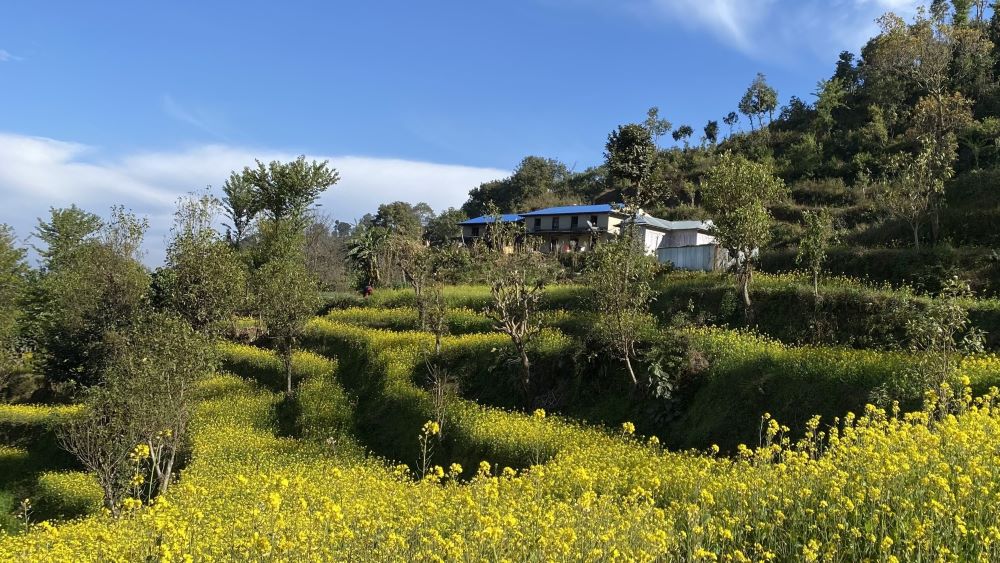
A building near a mustard field in bloom in a Nepalese village, 2021. Used with permission from the author.
Truth Listening as a grounded theory and the ‘Arc of Truth Listening’
This research developed Truth Listening as a feminist, listening-centered grounded theory. Truth Listening is the overarching theory while the Arc of Truth Listening is the seven-element framework that organises the relational conditions through which the theory can be understood and applied.
The Arc of Truth Listening has seven interlinked elements:
- Trust as the gateway to truth
- Confidentiality as an ethical and relational obligation
- Safe and respectful invitation to speak
- Listening slowly with emotional presence
- Non-judgmental and affirming listening
- Gentleness, patience, and care
- Listening that leads to action and holistic change
These elements should be understood and applied as relational conditions rather than a procedural checklist in the transitional justice processes. They make truthful engagement possible by creating safety before speech, care during listening, and responsibility after disclosure. Trust and confidentiality help survivors decide whether speaking is safe. A respectful invitation, slow listening, non-judgmental affirmation, and gentleness allow truth to emerge at the survivor’s pace. The first six elements establish the relational and ethical conditions for meaningful listening; the seventh extends listening into responsibility and action. It prevents listening from becoming another form of extraction. During the research, survivors made it clear that listening has meaning only when it leads to recognition, reparation, state accountability, healing, or change in how families, communities, and institutions treat them.
This article elaborates on the seventh element: Listening that leads to action and holistic change, which addresses what must happen after survivors are heard and places responsibility on institutions to respond.
Listening that leads to action and holistic change
During the research, survivors described their engagement with formal mechanisms as a painful lesson in the limits of procedural listening. Many had approached District Peace Committees, the Truth and Reconciliation Commission, or other official spaces with the hope that speaking would bring recognition, relief, or justice. Instead, they often encountered forms, fixed questions, male-dominated local structures, weak confidentiality, and little follow-up.
As Courageous-16 asked, ‘If we speak but nothing happens, then what is the use? Our lives remain the same.’ Courageous-28 described a similar disappointment after engaging with the formal mechanisms: ‘We have already told the government. However, what came from that? Nothing changed in our lives.’ For Courageous-17, speaking still carried a small hope for justice: ‘I realised that if I did not speak, nothing would happen. Speaking could lead to some justice or change.’
These reflections show that survivors are asking for more than testimony collection. They are asking whether formal mechanisms can protect their dignity, believe their truths, respond to their needs, and turn listening into recognition, reparations, accountability, and change.
This research shows that for survivors, Truth Listening can be a pathway to holistic change, which they define in three interconnected dimensions: Head, Hands, and Heart (the 3-H Model)
- Head refers to shifts in knowledge, awareness, and recognition. Survivors want to change how families, communities, officials, and institutions understand conflict-related sexual violence. For many women, the original harm continued through disbelief, blame, shame, and silence. Truth Listening must therefore challenge the social meanings attached to conflict-related sexual violence. Survivors are knowledge builders whose lived wisdom can reshape public memory, reparations, and the design of transitional justice.
- Hands refer to practical capacity, economic sustainability, and concrete support. Survivors named the importance of health care, psychosocial support, livelihood opportunities, legal assistance, documentation support, safe referral, and continued follow-up. Courageous-28 described it with an expanded meaning: ‘Access to health care, someone to listen to us, and support to live with dignity, that is justice for me.’ Courageous-15 made a similar point: ‘Accepting our story as truth and offering support for our children and livelihoods would help us to sustain.’ For survivors living with poverty, reproductive health concerns, family responsibility, and social exclusion, dignity cannot be separated from material survival. Ethical documentation also requires such follow-up because gathering survivors’ stories without support can reproduce harm.
- Heart refers to healing, contentment, dignity, and inner peace. Survivors described justice in emotional and relational terms as well as legal ones. Being believed and being treated without suspicion matters. Being able to sit with other women and feel less alone also matters. Courageous-14 described the healing force of collective recognition: ‘Once I started opening up and got out of the house, I noticed other sisters who had been through even worse. Seeing their pain made me realise I have risen above.’ Courageous-19, reflecting on her engagement with a female member of a civil society organisation, emphasised the importance of being treated with sincerity and care by the listener: ‘Everything, from the way she spoke to the way she treated us, felt genuine.’ These statements show that relationships, recognition, and dignity-affirming presence enable healing.
Figure 1: 3-H Model for Holistic Change
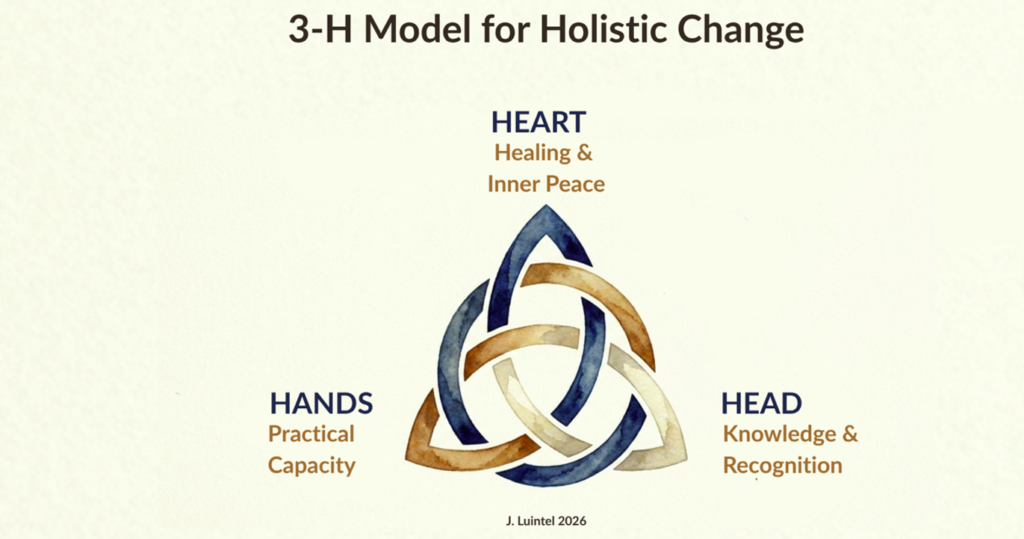
The 3-H model’s focus on action and holistic change turn Truth Listening from a technique into a responsibility and show how formal transitional justice can support healing, justice, and empowerment of women survivors. This emphasis on holistic change resonates with gender-transformative approaches to transitional justice.
Nepal’s transitional justice context and the erasure of conflict-related sexual violence
The 2006 Peace Agreement created the political basis for transitional justice by calling for a truth and reconciliation process. The Truth and Reconciliation Commission and the Commission of Investigation on Enforced Disappeared Persons were established in 2015.
For women survivors of conflict-related sexual violence, this nine-year delay was part of a wider pattern of erasure. Conflict-era rape, sexual violence, and torture were only weakly acknowledged and addressed in Nepal’s formal peace and transitional justice architecture. The Nepal government began the Interim Relief Program process soon after the Peace Agreement, with a multi-agency task force formed in 2007 and guidelines approved and implemented in 2008. But survivors of rape, sexual violence, and torture were largely excluded from these early relief and recognition processes.
Nepal’s first National Action Plan—on UN security council resolutions 1325 and 1820 implemented from 2011/12 to 2015/16 under the then Ministry of Peace and Reconstruction—did not create a clear pathway for addressing the needs of women survivors of conflict-related sexual violence. Nepal’s second National Action Plan adopted from 2022/23 to 2024/25, later created more explicit space for them. Yet the long gap between early relief, the first National Action Plan, and the delay in formal transitional justice left many women survivors unrecognised for years.
For many women survivors, institutional exclusion was compounded by stigma, gender norms, family and community pressures, and economic insecurity. These conditions made disclosure risky and prolonged the effects of delayed recognition and justice.
The important role of civil society organisations
Against this backdrop, civil society organisations in Nepal became important spaces for recognition, support, healing, and advocacy for women survivors of conflict-related sexual violence.
A few civil society organisations in Nepal such as Advocacy Forum, Human Rights and Justice Centre, Nagarik Aawaz and The Story Kitchen, played a vital role in keeping the demands of women survivors of conflict-related sexual violence visible. Some created safer spaces where women could be listened to, begin healing, recognise that the violence was not their fault, and move away from shame. Others advocated for legal recognition of women survivors and provided medical, psychosocial, legal, economic, and leadership support.
This role became especially important because formal transitional justice remained delayed, procedural, and mistrusted. Rape and sexual violence were severely underreported to the 2017-2018 Truth and Reconciliation Commission, partly because survivors lacked confidence in privacy, confidentiality, and survivor-sensitive procedures. Survivor organising later made amplification easier.
The Conflict Victim Women National Network, founded in 2020, created a national platform for women survivors of all types of human rights violations during armed conflict to seek rights, dignity, reparations, dialogue, and advocacy. In 2023, the National Association of Conflict Rape Victims, later named as Aparajit Foundation, also became a visible platform for women survivors of conflict-related sexual violence, demanding recognition, health care, and reparations.
In 2024, after the Truth and Reconciliation Commission reopened complaint registration, over 4,000 conflict-related sexual violence cases were registered with the Commission. But its call for registration was criticised for lacking adequate confidentiality, gender sensitivity, security safeguards, and psychosocial support.
What can formal transitional justice learn from informal processes?
Informal survivor-led and civil society-led spaces offer important lessons for formal transitional justice. In Nepal, many women survivors of conflict-related sexual violence experienced formal mechanisms as distant, procedural, and difficult to trust.
Civil society supported survivor-to-survivor and woman-to-woman spaces are places where survivors could share at their own pace, build solidarity, and say, ‘I am not alone,’ ‘my story matters,’ and ‘what happened to me, it was not my fault.’ My research shows that there is a similar pattern in other nations such as Bangladesh, Colombia, Kenya, Rwanda, and Timor-Leste.
Truth Commissions, reparations bodies, local governments, and survivor-support mechanisms need procedures built around trust, confidentiality, survivor choice, referral, and follow-up. A survivor-centred process requires trained listeners, safe documentation systems, psychosocial support, health care pathways, livelihood links, and mechanisms for survivors to influence decisions that affect them.
Truth Listening does not envisage that informal processes should replace formal justice. Rather, it shows what formal justice must learn. Civil society can bring relational knowledge, survivor trust, and community presence. Formal institutions can bring recognition, reparative authority, policy change, and accountability. When these forms of work are connected ethically, transitional justice becomes more responsive to survivors’ lived realities.
Conflict transformation in Asia
Truth Listening can contribute to wider debates on conflict transformation in Asia, which is concerned with more than the formal end of violence. It asks how relationships, structures, narratives, and power relations can be reshaped so communities can move toward more just forms of coexistence. For women survivors of conflict-related sexual violence, conflict continues in social stigma, economic insecurity, family silence, institutional neglect, and the absence of meaningful recognition. Transforming conflict, therefore, requires attention to the afterlives of violence.
The contribution of Truth Listening lies in its location of knowledge. It begins from survivors’ lived analysis rather than from an imported institutional template. Survivors understand how violence moves through the body, family, community, state, and memory. They understand why silence may protect, why speaking may endanger, and why justice must include recognition, practical support, state accountability, and dignity. Research with women survivors of conflict-related sexual violence in Rwanda similarly shows that survivors’ justice interests extend beyond formal proceedings to include safety, validation, and perpetrators taking responsibility for the harm caused. This knowledge is essential for conflict transformation because it reveals the structures that sustain harm after war has formally ended.
The Truth Listening framework also speaks to the politics of knowledge production in transitional justice where scholars have shown how institutional hierarchies, expert categories and methodological choices shape what is recognised as legitimate knowledge. Many transitional justice models have travelled across contexts through international institutions, expert frameworks, and technical language. Their limits become visible when they treat survivors mainly as sources of testimony rather than as thinkers of justice. Rather than a universal formula, Truth Listening offers an ethical orientation: listen slowly, protect dignity, respect silence, and ensure that listening leads to meaningful action.
Conclusion: From testimony to responsibility
The question facing transitional justice is no longer only how to create spaces where survivors can speak. The deeper question is how to build institutions capable of listening responsibly.
For women survivors of conflict-related sexual violence, meaningful listening is measured by what follows: recognition, state accountability, practical support, dignity, healing, and change. Research on post-conflict Nepal similarly shows that women’s agency and social transformation emerge through everyday negotiations with gendered structures. Truth Listening grounded theory reframes survivors as knowledge builders. Their lived wisdom shows that justice cannot rest on the collection of testimony and verdicts on paper alone. Through Head, Hands, and Heart, survivors define holistic change as empowerment through knowledge, survival, and inner peace. This is the central contribution of action-oriented Truth Listening. It asks transitional justice to transition from extracting testimonials to accepting responsibility.
Main image: Three women walk on a wall in Kathmandu, 2026. Photo by Wietse Jongsma on Unsplash.